
The Ultimate Guide to Warehouse Robotics: Technology, Benefits, and Real-Time System Collaboration
What Is Warehouse Robotics Technology?
AI and Machine Learning: The Decision Layer
AI serves as the operational core of modern warehouse robotics. Rather than executing static commands, the AI engine continuously analyzes a complex matrix of variables, including order history, SKU velocity, dynamic slotting logic, real-time battery levels, aisle congestion, and labor constraints. And then it translates raw data into executable, dynamic workflows. Machine learning (ML) models process real-time variables to optimize routing, predict demand surges, and rebalance workflows before bottlenecks occur. Furthermore, ML integration within WMS architectures addresses planning challenges, such as dynamic inventory slotting and optimized order-fulfillment sequencing.
Industry adoption of these systems is accelerating. For instance, MHI and Deloitte report that 84% of supply chain leaders plan to use AI technologies over the next five years.
SLAM, LiDAR, and Vision: The Navigation Layer
Once the AI assigns a directive, the navigation layer ensures safe, precise spatial execution.
- Fixed-path robots follow tapes, QR markers, rails, or magnetic guides.
- AMRs use SLAM to map their surroundings and localize themselves at all times.
- LiDAR uses laser pulses to measure distance.
- Vision-based navigation uses camera data to pinpoint its locations
So, in the context of warehouse robotics, when a pallet blocks an aisle, the smarter robot does not stop and wait. Instead, it recalculates, goes around the obstacle, and maintains the work.
Sensors, Edge Computing, and IoT: The Collaboration Layer
Advanced warehouse robotics relies on a robust hardware-software ecosystem to transition from isolated machines to a highly synchronized, collaborative fleet.
- Sensors capture signals about motion, load weight, temperature, proximity, and location.
- Edge processors execute localized, ultra-low-latency decision-making for time-critical events, bypassing cloud delays.
- IoT connects robots to WMS, WES, conveyors, scanners, and safety systems.
Relying exclusively on cloud infrastructure for micro-level decisions can cause unacceptable latency. By processing data at the edge, interconnected machines can instantaneously synchronize traffic patterns, trigger dynamic replenishment, prevent collisions, and update inventory records in milliseconds.
Essential Types of Warehouse Robotics
Autonomous Mobile Robots (AMRs): Flexible Task Carriers
AMRs are advanced, self-navigating robots that move through modern warehouses autonomously, requiring no fixed infrastructure, guide tapes, or human oversight. They specialize in safe, flexible material transport by dynamically avoiding obstacles and optimizing routes.
As per the International Federation of Robotics, the number of transportation and logistics robots sold increased by 35% in 2023, reaching approximately 113,000 units.
Automated Guided Vehicles (AGVs): Predictable Material Flow
AGVs are engineered for highly structured environments and disciplined traffic patterns. They are made to move pallets, carts, or containers through preplanned lanes using markers, wires, tape, or programmed guidance. In warehouse robotics, you may think of them as dependable industrial shuttles that make the same trips over and over again between receiving, storing, producing, and shipping.
AS/RS: Dense Storage with Fast Retrieval
Automated Storage and Retrieval Systems make use of cranes, shuttles, lifts, or cube-based mechanisms to compress inventory into vertical or high-density layouts. They retrieve items with machine-level accuracy. AS/RS is the heavy-duty foundation for warehouse robotics when floor space is limited and throughput cannot depend on how far people have to walk.
Cobots and Robotic Arms: Shared Workstations
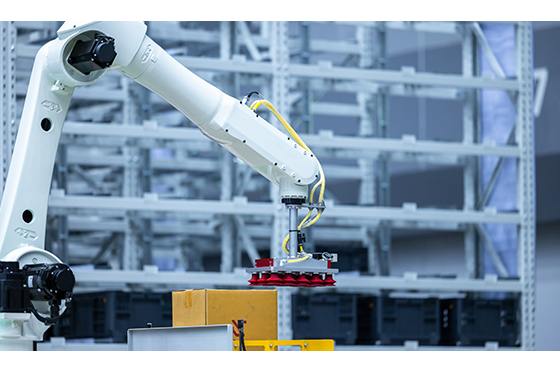
Cobots and robotic arms make picking, packing, kitting, palletizing, and handling exceptions simpler with automation. But they still need human judgment. This represents the ideal automation balance: machines execute high-volume, repetitive physical tasks, while human operators focus on quality control, exception handling, and complex decision-making.
Drones (UAVs): Aerial Inventory Intelligence
Drones introduce an overhead inspection layer since it scans barcodes, QR labels, or RFID-tagged stock in rack locations that are slow or dangerous to check manually. When it comes to warehouse robotics, UAVs are great for cycle counts, checking for discrepancies, and making it more straightforward to see what is in stock in tall storage areas.
Benefits of Warehouse Robotics Through System Collaboration
WMS Integration Turns Robot Activity into Inventory Accuracy
The true ROI of warehouse robotics emerges when automated fleets transition from isolated operations to integrated workflows, constantly transmitting data on task status, SKU movement, and exceptions to the WMS. By capturing every pick, put-away, transfer, and replenishment cycle instantaneously, the system continuously updates the digital inventory ledger in real time. This synchronization lowers the risk of discrepancies between physical floor stock and digital records.
Fleet Orchestration Converts Many Robots into One Workflow
While individual robots provide localized speed, a synchronized fleet delivers systemic intelligence. Orchestration software assigns jobs while keeping in view the location, workload, priority, charge level, and risk of congestion. This coordination layer in warehouse robotics stops dead zones, keeps work flowing, and balances usage instead of letting machines fight for the same aisle or station.
MHI and Deloitte also think that 82% of businesses will use robotics and automation within five years. As adoption scales, advanced fleet orchestration will shift from a competitive advantage to a baseline operational requirement.
Live Operational Data Makes Scaling Less Risky
As the volume increases, managers need more than just dashboards. They need to be able to see bottlenecks, dwell time, task queues, and exception patterns at the event level. Here, warehouse robotics can grow. Real-time data helps teams adjust their labor, storage, replenishment, and automation capacity before small delays turn into problems for the whole network.
Human-Robot Collaboration Improves Safety and Space Use
Collaborative automation helps eliminate repeated lifting, long travel paths, and awkward reach movements, as well as lets people concentrate on inspection, packing, and problem-solving. Rather than attempting to replace human judgment, this model augments it by neutralizing physical strain. Furthermore, purpose-built human-machine workflows inherently enhance safety protocols in shared environments while enabling more efficient workstation layouts.
Overcoming Challenges in Warehouse Robotics Implementation
High Upfront Costs vs. Robotics-as-a-Service (RaaS)
CAPEX vs OPEX: Choosing the Funding Logic
In warehouse robotics, the first barrier is financial architecture, not engineering. While CAPEX models require heavy upfront investment in hardware and software, OPEX models like Robotics-as-a-Service (RaaS) convert automation into a flexible, recurring operational expense, minimizing financial risk.
RaaS: Scaling Without Overcommitting
Thanks to RaaS, warehouse robotics might be added gradually since capacity can grow by site, shift, workflow, or peak season instead of having to roll out the whole facility all at once. This scalability is critical for operations managing volatile demand cycles. Increasingly, subscription-based models are focused on flexible deployment, quicker customization, and less pressure on capital.
Market momentum underscores this structural shift. Technavio says that the global RaaS market will grow by USD 2.49 billion between 2023 and 2028, at a CAGR of 23.47%. This aggressive growth trajectory highlights the rapid industry transition from heavy CapEx ownership toward agile, subscription-based automation models.
Integration Complexity Across Legacy Systems
Legacy Infrastructure: The Hidden Integration Tax
Integrating modern robotics with legacy ERP modules, RF workflows, PLC-controlled equipment, and batch-file interfaces is often the most complex hurdle in deployment. While the robotic hardware may be state-of-the-art, deploying it into a software environment constrained by batch-file processing, legacy interfaces, and fragmented SKU logic transforms the implementation into a complex interoperability challenge.
Modular Interoperability: Making Old and New Systems Speak
The best way to do this is through modular integration, and this may include API layers, middleware, event queues, standard data models, and staged pilots that let new automation connect without forcing a costly rip-and-replace of legacy infrastructure. This strategy allows operations to modernize workflows while maintaining continuous business uptime. Ultimately, a successful deployment relies on three critical pillars: staged pilots, low-latency data synchronization, and automated exception handling.
Future Trends Shaping Warehouse Robotics
Hyper-Intelligent AI and Digital Twins
The "test-before-you-change" model is the next big thing in warehouse robotics. Digital twins simulate slotting rules, aisle pressure, labor waves, equipment use, and peak-season situations before any real changes are made. By stress-testing throughput and fine-tuning predictive control logic in a risk-free digital environment, operations directors can proactively identify hidden bottlenecks and validate layout changes without disrupting live workflows
Sustainable and Green Logistics
Not only will the number of units per hour be used to measure the future of robotics in warehouse operations, but also watts, carbon, heat load, idle time, and space intensity. In modern facilities, operational performance and environmental sustainability are intrinsically linked. Intelligent automation minimizes empty travel time, optimizes energy-intensive facility systems, compresses required storage footprints, and executes material flow with lower emissions.
The financial and environmental impact of optimizing these metrics is substantial. E.g., energy intensity in distribution centers may vary from under 50 to over 600 kBtu/ft², and high-consuming facilities may use 16 times more energy than low-consuming ones.
NEXCOM's industrial automation, robotics control, edge AI, and TSN solutions enable real-time coordination across warehouse automation systems. Explore our solutions to improve operational efficiency, safety, and system integration.
- Related Links:
- What Is an Industrial Robot Controller? A Complete Guide
- What is an Industrial IoT Gateway? The Ultimate Guide for Industry 4.0
- Browse Other News:
- What Is an Industrial Robot Controller? A Complete Guide
- What is an Industrial IoT Gateway? The Ultimate Guide for Industry 4.0
- All Blog News
