
What Is an Industrial Robot Controller? A Complete Guide
Industrial robots are now central to advanced manufacturing, semiconductor production, electronics assembly, logistics automation, machine tending, and smart factory operations. Behind every precise robotic movement is a control system that coordinates motion, processes feedback, communicates with field devices, and supports safe operation. This control system is the robot controller.
It determines how the robot moves, how accurately it follows a path, how it responds to sensors, and how it integrates with the wider automation environment. For robot builders, machine builders, and system integrators, controller selection directly affects robot performance, system stability, safety design, and long-term scalability.
Industrial robot adoption continues to expand worldwide. According to the International Federation of Robotics, annual global industrial robot installations reached 542,000 units in 2024, more than double the volume recorded ten years earlier. As robot deployment increases, the controller is becoming a strategic platform for motion control, AI integration, industrial communication, and functional safety.
What is a Robot Controller?
A robot controller is a hardware and software system that manages the operation of a physical robot. It interprets programmed instructions, calculates motion trajectories, processes real-time feedback, communicates with external devices, and sends commands to servo drives, motors, grippers, sensors, and safety systems.
In industrial automation, the controller converts digital commands into controlled mechanical motion. It coordinates the robot's axes, manages timing, monitors operating conditions, and ensures that the robot performs tasks with the required precision, speed, and repeatability.
The "Brain" of the Industrial Robot
Think of the robot controller as an industrial robot's brain. It does not simply start and stop movement. It coordinates multiple subsystems in real time and controls how the robot behaves across different production scenarios.
For instance, in a robotic welding application, the controller maintains path accuracy, travel speed, and tool orientation. In a machine-tending cell, it synchronizes robot motion with CNC machines, doors, fixtures, and sensors. In a vision-guided picking system, it uses object-position data to adjust the robot path before motion begins. In collaborative robot applications, it works with safety sensors and monitored zones to reduce operational risk.
A modern industrial robot controller therefore serves as the central coordination layer between mechanical motion, software logic, field devices, safety systems, and factory networks.
How Does an Industrial Robot Controller Work?
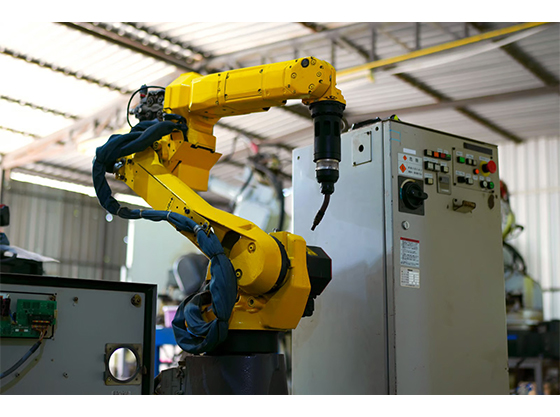
An industrial robot controller works by converting programmed commands into coordinated movement: calculating motion paths, sending commands to drives and motors, and reading feedback from sensors and encoders to confirm the robot is executing as planned. In advanced systems, this same loop extends to vision data, AI inference, conveyor tracking, and multi-robot synchronization — the fundamentals of which are covered in the sections below.
Key Functions and Capabilities
Motion Control and Path Planning
Motion control defines how the robot moves. The controller calculates the required position, speed, acceleration, deceleration, and orientation for each axis. For multi-axis robots, it synchronizes joint movement, so the end effector reaches the target point accurately and efficiently.
Path planning determines how the robot travels through space. In applications such as dispensing, welding, cutting, inspection, and assembly, the robot must follow a controlled path rather than simply move between two points. The controller manages interpolation, trajectory smoothing, speed control, and tool-center-point positioning to maintain process quality.
For high-speed production machines, motion quality directly affects throughput and repeatability. A capable robot controller reduces vibration, improves trajectory control, and supports stable operation across demanding production cycles.
Real-Time Feedback Processing
None of this works without real-time feedback. Encoders, torque sensors, force sensors, proximity sensors, machine vision, and I/O devices feed the controller data it uses to confirm position, detect errors, adjust movement, and catch abnormal behavior before it becomes a problem — critical for maintaining precise torque, velocity, and position control in servo-driven systems.
This matters most in applications where timing is tight: conveyor tracking, vision-guided robotics, force-controlled assembly, high-speed picking, and collaborative robot operation. Delayed feedback reduces control accuracy and increases the risk of unstable machine behavior.
I/O Integration and Communication
Industrial robots operate as part of a larger automation system. A robot controller must communicate with PLCs, HMIs, sensors, grippers, conveyors, safety devices, machine tools, vision systems, and factory networks.
A strong controller architecture supports both local I/O and industrial communication protocols. Common protocols include EtherCAT, EtherNet/IP, PROFINET, Modbus TCP, and CANopen, supported through various interfaces such as RJ45, RS232/422/485, DI/DO, and GPIO.
EtherCAT is widely used in high-speed motion control because it supports deterministic communication and synchronized multi-axis operation. EtherNet/IP and PROFINET are common in factory automation environments that require broad PLC and network integration.
Communication capability determines how easily the robot fits into the production line. It also affects commissioning speed, troubleshooting efficiency, and long-term system expansion.
Safety Monitoring
Safety is a core controller function in modern robotics. The controller must support defined safety responses when hazardous conditions occur, including stop functions, speed limitation, workspace restriction, and safe recovery from abnormal states.
The ISO 10218-1 robot safety standard specifies safety requirements for industrial robots, including design requirements, risk reduction measures, and information for use. These requirements make safety a system-level consideration that begins with controller architecture.
Common safety-related functions include emergency stop, protective stop, safe torque off, speed limitation, workspace limitation, safety-rated monitored stop, collision detection, and safe shutdown behavior—functions that matter even more as cobots and flexible production cells put humans and robots in closer proximity.
Core Components of a Robotic Control System
Delivering those functions depends on a specific set of hardware and software components: computing hardware, motion-control drives, communication interfaces, feedback devices, and operator interfaces. Here's what each one does.
CPU and Main Board
The CPU and main board provide the computing foundation of the robot controller. They execute control software, calculate motion commands, manage real-time tasks, process feedback, and coordinate communication with external devices.
In advanced robotic systems, the controller also handles machine vision, AI inference, sensor fusion, data logging, and predictive maintenance functions. This is why many modern robot controllers are evolving into industrial edge computing platforms.
Processing performance affects control cycle time, axis coordination, vision-processing capability, communication bandwidth, and software scalability.
Servo Drives and Amplifiers
Servo drives and amplifiers convert controller commands into controlled motor output. They regulate torque, speed, and position based on feedback from encoders or sensors.
In a multi-axis robot, each joint requires precise servo control. The controller coordinates these drives to produce smooth, synchronized movement across the entire robot structure.
Servo control quality affects repeatability, speed, vibration, payload handling, and path accuracy. In high-performance industrial robotics, servo coordination is a key factor in production quality.
I/O Modules and Communication Interfaces
I/O modules connect the controller to external devices such as sensors, actuators, grippers, safety devices, conveyors, fixtures, and signal towers. Communication interfaces connect the robot to PLCs, HMIs, edge computers, vision systems, and factory networks.
A flexible industrial robot controller provides sufficient I/O capacity and protocol support for current and future system requirements. Limited connectivity increases integration complexity and restricts expansion.
Teach Pendant (Operator Interface)
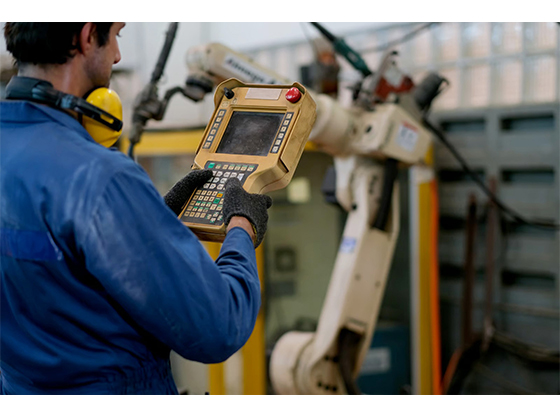
A teach pendant is the operator interface used to program, configure, jog, and monitor the robot. It supports setup, commissioning, troubleshooting, and maintenance operations.
Operators use the teach pendant to teach positions, adjust motion paths, check alarms, review system status, switch operation modes, and execute manual control tasks.
An effective operator interface improves commissioning efficiency, reduces training requirements, and supports safer interaction during setup and maintenance.
Types of Robot Controllers in the Market
Robot controllers differ by architecture, processing capability, programming environment, and integration model. The right controller type depends on the robot structure, application requirements, communication needs, and required level of software flexibility.
PC-Based Motion Controllers
PC-based motion controllers use industrial PCs or embedded computing platforms to run robot-control software. They provide strong processing performance, open software architecture, and flexible integration with vision, AI, data, and motion-control systems.
These controllers are suitable for advanced robotics applications that require high computing power, multi-axis coordination, and integration with third-party software or devices.
Typical applications include vision-guided robotics, semiconductor equipment, CNC systems, packaging machines, precision assembly, robotic inspection, AI-enabled robots, and multi-axis production machines.
PC-based controllers provide strong flexibility for robot builders that need customized motion logic, real-time software, and scalable system architecture.
Embedded PLC-Style Controllers
Embedded PLC-style controllers combine machine-control reliability with robot-control functionality. They are commonly used in applications where deterministic control, stable operation, and familiar automation logic are primary requirements.
These controllers are suitable for machine tending, simple robotic cells, assembly systems, material handling, packaging automation, and production equipment with defined motion requirements.
They provide strong reliability and straightforward integration with traditional factory automation systems.
Open-Source and ROS-Based Controllers
ROS-based controllers are used in research, mobile robotics, autonomous systems, and advanced robot development. The ROS 2 documentation highlights middleware flexibility as a key factor in distributed robotic system design.
ROS-based architectures provide useful tools for perception, navigation, simulation, planning, and robot software development. For industrial deployment, they require a robust control architecture that addresses real-time performance, reliability, cybersecurity, safety validation, and lifecycle support.
Production-ready ROS-based systems typically combine open-source development flexibility with industrial-grade hardware, real-time control layers, and validated safety subsystems.
The Future of Industrial Robot Controllers
Industrial robot controllers are shifting from dedicated motion-control devices into intelligent automation platforms. Modern controllers must handle motion, perception, communication, safety, AI processing, and data integration within one system architecture.
AI and Edge Computing Integration
Next-generation controllers no longer execute fixed motion programs. With built-in AI and edge computing, they process visual data, detect objects, optimize paths, identify defects, monitor equipment health, and respond to changing production conditions—all with processing handled close to the robot rather than in the cloud, which reduces latency and improves reliability.
The NIST robotics program focuses on measurement science for manufacturing robot performance, collaboration, agility, autonomy, safety, and implementation. This reflects the direction of industrial robotics: controllers must support both precise motion and intelligent decision-making.
For robot builders, that means evaluating controllers on AI workload capacity, sensor-fusion capability, and software scalability, not just motion performance.
Collaborative Robots (Cobots) and Advanced Functional Safety
Collaborative robots require more advanced controller safety functions because they operate closer to human workers. Controllers must manage safe speed, force limitation, workspace boundaries, protective stop behavior, proximity sensing, and controlled recovery.
Functional safety and cybersecurity are also becoming more connected. As robots communicate through industrial networks and edge systems, secure communication and controlled access become essential to operational safety.
Together, these trends point to where the controller is headed: from a motion-control device to the central platform connecting robot intelligence, safety, and factory execution.
How to Choose the Right Industrial Robot Controller?
Selecting the right industrial robot controller requires a structured evaluation of robot mechanics, motion requirements, communication protocols, safety needs, computing performance, and expansion plans.
The controller must fit the application's current technical requirements while supporting future system upgrades.
Compatibility and Payload Requirements
The controller must match the robot's mechanical structure, number of axes, payload, kinematics, servo system, and required operating performance.
A Cartesian robot, SCARA robot, Delta robot, wafer robot, six-axis arm, and seven-axis robot each requires a different motion-control approach. Payload also affects acceleration, braking, torque control, vibration, and path stability.
Key evaluation factors include robot structure, controlled axes, payload, inertia, repeatability, speed, end-effector type, feedback requirements, and multi-robot coordination.
Processing Performance and Expansion Flexibility
Processing performance determines whether the controller can manage real-time motion, high-speed feedback, industrial communication, machine vision, and AI workloads.
A controller for advanced robotics must support deterministic execution, sufficient computing capacity, flexible I/O expansion, software customization, and long-term platform availability.
Expansion flexibility is critical because automation systems frequently evolve after deployment. Additional sensors, new grippers, more axes, AI modules, remote monitoring, and factory-system integration all require a controller architecture that supports growth.
Supported Industrial Communication Protocols
As covered earlier, protocol support (EtherCAT, EtherNet/IP, PROFINET, CANopen) directly affects how easily the robot integrates into existing factory networks. This should be weighed against your site's installed automation ecosystem.
Partner with NEXCOM Robotic Solutions
Selecting the right industrial robot controller is a critical step in building robots that are precise, reliable, safe, and ready for future automation demands. As industrial robots continue to integrate motion control, real-time feedback, AI computing, and factory communication, robot builders need more than a component supplier; they need a partner who understands control architecture from the ground up.
NEXCOM Robotic Solutions (NexCOBOT Co. Ltd.) supports robot builders, machine builders, and system integrators with the computing, communication, and motion-control foundation needed to develop advanced robotic systems for modern manufacturing environments. To build smarter, safer, and more scalable industrial robots, contact NEXCOM today and explore the right approach for your next automation project.
- Related Links:
- What is an Industrial IoT Gateway? The Ultimate Guide for Industry 4.0
- EtherCAT vs. EtherNet/IP: A Complete Comparison for High-Speed Motion Control
- Browse Other News:
- What Is an Industrial Robot Controller? A Complete Guide
- What is an Industrial IoT Gateway? The Ultimate Guide for Industry 4.0
- All Blog News
