
AS/RS Warehouse Automation: Enhancing Flexibility with AMRs
What Is an Automated Storage and Retrieval System (AS/RS)?
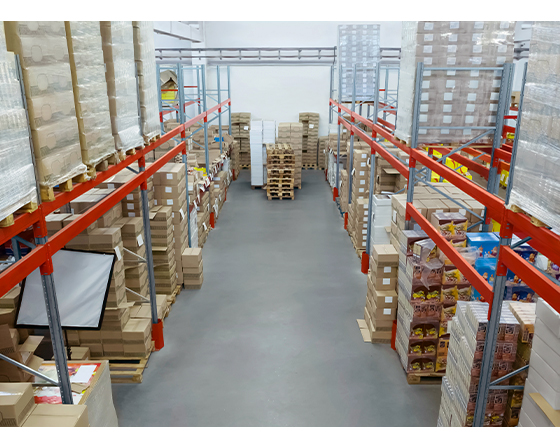
In modern warehouse operations, speed, space utilization, and inventory accuracy are essential to maintaining efficient fulfillment. Automated Storage and Retrieval Systems, or AS/RS, help address these needs by automating how goods are stored, located, and retrieved within a controlled warehouse environment.
The Core Mechanism
An Automated Storage and Retrieval System is a computer-controlled storage architecture that makes use of software, sensors, and electromechanical handling equipment to put inventory in specific places and get it back on demand with repeatable precision eliminating the need for manual transport and put-away workflows.
Why Engineers Like It
One of the most established forms of warehouse automation relies on fixed infrastructure, such as aisle-bound stacker cranes and shuttle vehicles that run on predetermined paths. This cuts down on search time, improves location accuracy, and makes use of vertical cube space that conventional fork-truck layouts might leave empty. Peer-reviewed AS/RS research indicates that a primary motivation for the adoption of these systems was to get rid of walking from the picking process, which constituted 70% of manual retrieval time.
Where the Trade-Off Appears
However, rigid infrastructure struggles when SKU velocity, order profiles, or slotting logic experience sudden shifts. An AS/RS is very connected to dedicated rack geometry, controls, and material-flow design. So it comes with heavy initial capital commitment and limited process agility. This is why an AMR warehouse model and a bigger AMR warehouse automation strategy come up when operations need to be able to change their workflow more quickly.
How AMRs Bring Flexibility to AS/RS Warehouse Systems
Breaking the Limits of Fixed Infrastructure
Navigation Moves from Hardware to Software
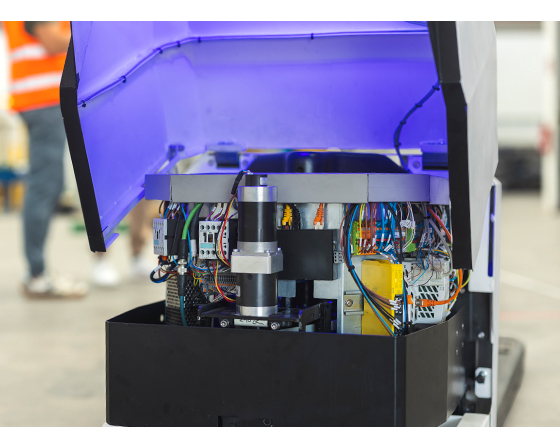
Intelligent mobility fundamentally shifts navigation from hardware to software. AMRs do not depend on built-in guide paths or aisle-bound transfer logic. Instead, they use onboard perception to find their way and constantly recalculate their travel decisions. In other words, transport orchestration changes from welded material-flow architecture to software-controlled mission routing.
Adaptation Happens in Real Time
Whether relocating a replenishment zone twenty meters, staging a temporary promotional packing cell, or navigating dynamic forklift traffic, the fleet manager can change maps, traffic priorities, and task assignments digitally in an AMR warehouse. Robots can also change their plans around traffic, people, and obstacles without stopping the whole operation to fix mechanical problems.
The Contrast with Conventional AS/RS Is Structural
The main difference is that traditional AS/RS motion logic is closely linked to engineered transport topology. On the other hand, in an AMR warehouse, horizontal movement is not linked to permanent conveyance infrastructure. This makes it much faster to reconfigure processes materially when order patterns, slotting rules, or service commitments start to change.
Scalable Automation for Peak Demand
Capacity Expands in Modules, Not Megaprojects
Facilities no longer need to overbuild for maximum theoretical capacity to handle short-term peak demand. AMR warehouse automation works as a fleet-and-software layer. As a result, operators can introduce more robots, workstations, or storage interfaces for the sake of more throughput in smaller increments instead of starting another big mechanical expansion cycle.
Robot Count Can Track Workload Curves
Robot counts can precisely track workload curves: operations can commission more units during order surges and repurpose or park them during lulls. Consequently, the site can be much better at handling changes in workload than fixed-capacity transport systems.
The Economics Improve Because Flexibility Is Operational
Financially, operators reduce the risk of stranded automation, maintain service levels high during busy times, and get a more responsive cost structure, thanks to the added capacity in smaller chunks and activated in a very short timeframe. This way, they do not have to pay up front for throughput that may not be used for most of the year. Economic pressure drove such a change. In the 12 months ending 2023, transportation and warehousing workers' wage-and-salary expenses climbed 7.1% compared to 4.3% for private business.
The Brain of the System: WMS Integration
WMS Is the Command Plane
In a hybrid automation environment, where both storage equipment and mobile robotics are being utilized, the Warehouse Management System (WMS) serves as the central command plane. It maintains the authoritative inventory record, controls the logic for fulfilling orders, and sets the order of execution for all activities, both incoming and outgoing. This provides the operation with one transactional foundation instead of separate control islands.
Integration Turns Motion into Managed Execution
To synchronize hardware and software, the WMS in an AMR warehouse exchanges task intents and status events with automation interfaces so that AS/RS equipment can confirm stock movements while mobile robots get work instructions, report completion, and send location-state updates back into the same digital thread. This is why vendors now expose APIs for AMRs and AS/RS and why an AMR warehouse automation stack is only as strong as its software integration model. In a mature AMR warehouse, that means less handoff latency, better handling of exceptions, and much better control over every point where inventory is touched.
Better Data Produces Faster Operational Decisions
Now think about what happens when the platform can see all the tasks, queues, and stock states as they happen. When the WMS is constantly ingesting execution feedback, it begins to speed up operational responses through dashboards, recommendations, dynamic work sequencing, and workflow optimization. Thus, visibility improves, reaction time compresses, and warehouse processes are tuned with evidence. And a well-used intelligence layer may provide measurable results. Through control-tower-style decision support, AI-enabled distribution operations may lower inventory by 20% to 30%, logistics costs by 5% to 20%, and better fill rates by 5% to 8%.
Elevate Your Warehouse with AMR Automation
Upgrading legacy AS/RS with AMR flexibility is no longer just a modernization strategy. It is now an operational necessity for facilities that require scalable efficiency. NEXCOM bridges the gap between static infrastructure and dynamic robotics. We empower this transition through our IoT Automation Solutions, industrial robot control expertise, and open-standard integration. Backed by a comprehensive global service model, we deliver the customized logistics, local access, and real-time support required to keep your automated fleet running at peak performance.
If you are also ready to move from planning to execution, check out NEXCOM's automation portfolio or connect with us through our inquiry channel to schedule a technical consultation with our engineering team.
- Related Links:
- Hybrid Video Surveillance Architecture: What Stays Local and What Moves to the Cloud
- What Is an Industrial Robot Controller? A Complete Guide
- Browse Other News:
- Hybrid Video Surveillance Architecture: What Stays Local and What Moves to the Cloud
- What is an Industrial IoT Gateway? The Ultimate Guide for Industry 4.0
- All Blog News
