
|
|
NEXCOM Networking and Communication: Powerful Enterprise Networking Solution for Cybersecurity Application
NEXCOM Network and Communication Solutions Busines...
NEXCOM Networking and Communication: Powerful Enterprise Networking Solution for Cybersecurity Application

|
|
|
NEXCOM, Stand Up to the Challenges of OT Network Security
Learn how NEXCOM’s ISA 140 addresses everyday chal...
NEXCOM, Stand Up to the Challenges of OT Network Security
|
AMR vs AGV: What's the Difference?
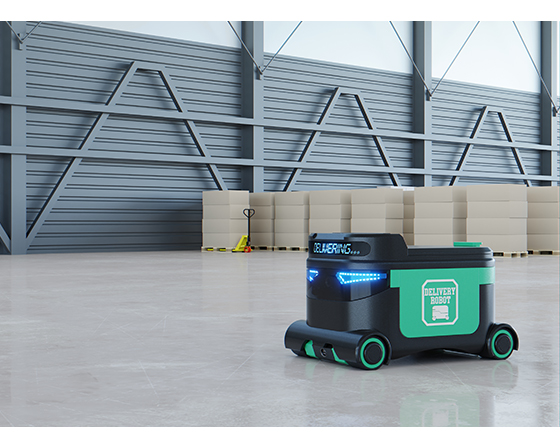
What Is the Difference Between AGV and AMR?
AGV: Guidance Built into the Route
At its core, an automated guided vehicle (AGV) is a driverless transport system. It moves loads through a facility by following set paths, such as wires, magnetic tape, rails, reflectors, or floor markers. Thus, its travel logic is set ahead of time, not made up on the spot.
AMR: Intelligence Built into the Vehicle
In contrast, an autonomous mobile robot (AMR) relies on onboard intelligence. It maps its surroundings, finds its way around, and uses sensor-driven path planning to move around obstacles in real time instead of following a hardcoded lane. That is the AMR vs AGV split. On the one hand, AGVs follow set paths. AMRs, however, break free from fixed routes. They leverage real-time perception, sophisticated software, and embodied AI to navigate their environments dynamically.
Why the Distinction Matters in Automation
In 2023, IFR registered more than 205,000 professional service robots. Meanwhile, transportation and logistics accounted for 113,000 of those particular units.
But where does each one fit into industrial automation? AGVs are better for material handling automation when the routes are the same and closely controlled. AMRs, however, are better for warehouse robotics and intralogistics environments where layouts, traffic, and task priorities frequently change. By using Embodied AI, AMRs can dynamically perceive and adapt to their surroundings, making them better suited for flexible, fast-changing automation environments
AGV vs AMR: 5 Key Differences
When operations teams stop talking about theory and start making plans for a rollout, where do the differences show up? When you look at how each platform moves, reacts, installs, expands, and computes on a live production floor, the answer to AMR vs AGV comes to the surface.
1.Navigation
First, think about route logic. AGVs use engineered guidance references such as tape, QR codes, optical lines, or reflectors to figure out where to go next. AMRs use onboard perception, digital maps, and SLAM navigation to figure out where to go next without being stuck in one corridor. That choice of architecture is what makes the rest of the comparison work the way it does.
2.Obstacle Handling
What happens if a worker crosses traffic or a pallet is left in the aisle? A traditional AGV will stop and wait. This is because its travel envelope is already engineered. In comparison to this, an AMR can slow down, check for open space, and change its route when the rules of the site allow it. This is because it can combine sensing with obstacle avoidance logic.
3.Deployment
Next is commissioning. That is the moment when a lot of projects either speed up or slow down. Setting up physical routes and layouts might be part of implementing AGVs. According to Swisslog, it takes 6 to 10 months for an AGV project to go live after it is ordered. In contrast, AMRs are introduced to existing warehouse automation systems through mapping, software configuration, and system integration. It makes them appealing for quicker upgrades.
4.Flexibility and Scalability
When looking at scalability, consider how the system adapts if throughput targets change next quarter. This is where the AGV vs AMR choice becomes strategically important. AMRs are easier to move, re-task, and add to through robot fleet management platforms. On the other hand, AGV growth may require more route engineering and changes to the floor.
5. Intelligence and Edge Computing
The compute stack separates them even more. AMRs need to constantly localize, perceive, and plan. Hence, they depend on the robust edge computing required to power Embodied AI, enabling mapping, inferring, over-the-air updates, and collaborative fleet orchestration. However, AGVs need a shorter decision loop since their motion model is more limited.
| Factor | AGV | AMR |
|---|---|---|
| Navigation | Follows installed guidance cues and preplanned travel lanes | Uses map-based self-localization and route computation |
| Obstacle Handling | Stops when the path is blocked | Can assess the scene and select an alternate way through |
| Deployment | Needs more site preparation and route setup | Begins with mapping and software integration |
| Flexibility and Scalability | Better for stable and repeatable flows | Better for changing layouts, variable demand, and fleet growth |
| Intelligence and Edge Computing | Lower autonomy burden, more deterministic control | Heavier onboard and edge processing for perception and decision-making |
When Should You Choose AGV or AMR?
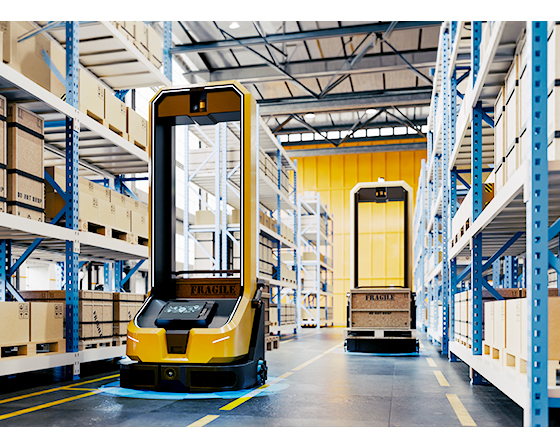
AGV Use Cases
Do you have milk runs, line-side replenishment, or pallet moves between the same pickup and drop-off points every shift? That is where AGVs earn their keep. The reason is that deterministic travel logic works best for assembly supply, buffer-to-line transfer, and other firmly sequenced intralogistics tasks. Here, sticking to a set route is more important than being flexible.
AMR Use Cases
What about facilities in which the aisles, priorities, and work orders change throughout the day? In this case, AMRs work well in dock-to-storage flows, mixed production support, and e-commerce fulfillment settings. They are made for busy shared spaces along with changing traffic patterns, frequent load variations, and continuous task reassignment.
Facility Layout
Before you look at the specs, ask a simpler question. Is the building's geometry stable or moving? When it comes to AMR vs AGV decisions, AGVs win when the floor plan is predictable and the process zones are locked. AMRs win when the layout needs to be changed often or needs to remain usable during maintenance, seasonal resets, or cell changes.
Operational Flexibility
Now think about the workflow itself, just beyond the map. Do the dispatch rules remain the same, or do jobs need to be moved up the list during the shift? AMRs are more worthwhile when the demand for transportation changes due to the mix of orders, the availability of workers, or the status of the station. The reason might be that software-led fleet orchestration can change missions and routes without having to rebuild the transport logic on the floor.
Scalability Needs
What happens when the volume doubles or a second area goes online? Deciding on AGV vs AMR for long-term planning, AMRs are easier to add to new workflows and production volumes by expanding the fleet and updating the map. This renders them appealing for plans to grow smart factory logistics and warehouse fulfillment.
How NEXCOM Accelerates Intelligent AMR Deployment
At NEXCOM, we speed up the deployment of AMRs by giving robot builders the computing power, connectivity, and integration hooks they need to go from idea to production. Our NVIDIA Jetson-based platforms are for on-device inference workloads and can deal with 20 to 275 TOPS. Our RCB 600 controller supports x86-64 ROS development with CAN, GPIO, and COM for machine vision and peripheral coordination. Meanwhile, our ISA 141 adds compact DIN-rail networking with dual Wi-Fi, dual 5G for seamless failover and uninterrupted wireless connectivity in OT infrastructure.
We also make these platforms to be used in the industry. They have fanless designs, selected IP67 models, support for a range of temperatures, shock and vibration compliance, and field connectivity for cameras, LiDAR, and cyber-physical systems. Thus, system integrators can build reliable industrial AMR solutions with fewer deployment worries. Check out our solutions or get in touch with us to find out which architecture works best for your robotics program.
FAQs About AGV and AMR
Are AMRs expensive to deploy?
Not always. AMR deployment costs can be higher at the robot level than for a basic guided system. But the project's finances get better because you do not have to do as much retrofit work, stop production, or change routes that come with fixed guidance infrastructure. MiR says that many customers see AMR payback in 12 to 18 months. Its financing example prices deployment at €575 per month, which is €7.99 per hour on a 48-month lease with 160 hours per month.
How do AMRs navigate? Do they require facility modifications or floor tracks?
Minimal facility modifications are needed. This is where the power of Embodied AI truly shines. Instead of following physical tracks, embedded wires, or magnetic strips like an AGV, an AMR uses advanced onboard perception (such as LiDAR and machine vision) powered by edge computing to build a real-time digital map of your facility. It then uses intelligent path planning to navigate dynamically, bypassing unexpected obstacles on the fly just like a human worker would.
Are AMRs safe in narrow aisles or with human workers?
Yes, when the application is engineered correctly. While traditional AGVs typically rely on simple sensors that force a rigid, hard stop when their path is blocked, AMRs leverage embodied AI to contextually understand their environment. By utilizing advanced personnel detection, safety laser scanners, and edge-level decision-making, an AMR can distinguish between a static pallet and a moving worker. It complies with strict safety standards like ISO 3691-4 by executing controlled slowdowns, dynamically routing around people, or stopping gracefully in busy shared spaces.
How does AMR maintenance differ from AGV maintenance?
To put it another way, AMR maintenance is more about keeping sensors healthy, wheels from wearing out, batteries charged, maps up to date, and software versions in sync across the fleet. AGV service is more about the external guidance layer that helps the vehicle follow its path.
- Related Links:
- NEXCOM Group to Showcase Full-Spectrum Smart Manufacturing Solutions at ISA Automation Summit & Expo 2026
- From Power Grid to Smart Factory: NEXCOM Group Lands in Texas, Six AIoT Solutions Connect with Critical Supply Chains
- Browse Other News:
- Hybrid Video Surveillance Architecture: What Stays Local and What Moves to the Cloud
- What is an Industrial IoT Gateway? The Ultimate Guide for Industry 4.0
- All Blog News
