
|
|
NEXCOM Networking and Communication: Powerful Enterprise Networking Solution for Cybersecurity Application
NEXCOM Network and Communication Solutions Busines...
NEXCOM Networking and Communication: Powerful Enterprise Networking Solution for Cybersecurity Application

|
|
|
NEXCOM, Stand Up to the Challenges of OT Network Security
Learn how NEXCOM’s ISA 140 addresses everyday chal...
NEXCOM, Stand Up to the Challenges of OT Network Security
|
Smart Rail Operations Requires New Network Foundation
Smart Rail Operations Requires New Network Foundation
As rail systems evolve toward smarter, more connected operations across tunnels, rural segments, and mixed public–private coverage zones, connectivity requirements for monitoring and control continue to intensify. At the same time, safety and operational functions demand deterministic performance, leaving no margin for downtime, latency spikes, or unpredictable behavior.
This convergence exposes a structural limitation in legacy rail communications. Smart rail operations depend on Communications-Based Train Control (CBTC) for continuous train supervision, while the transition toward the Future Railway Mobile Communication System (FRMCS) is redefining expectations for broadband, latency, and reliability. Together with real-time infrastructure intelligence and coordinated operations across distributed assets, these requirements demand deterministic, zero service downtime connectivity.
Rail solution providers and system integrators are under growing pressure to evolve beyond connectivity-centric deployments and deliver intelligent, mission-critical rail platforms aligned with CBTC and FRMCS roadmaps, built on unified, resilient architectures for continuous operation.
Operational Constraints of Legacy Rail Communication Networks
Rail communication environments are inherently challenging for conventional network designs. Trains and transit vehicles move across heterogeneous radio conditions, including urban public 5G coverage, privately operated tunnel networks, and rural areas where public 5G may be weak or unavailable. These transitions occur at high speed and often within seconds.
From an operational perspective, the key problems are clear:
- Network handovers at high speed risk service interruption
- Public and private networks operate as fragmented domains
- Physical network separation increases cost and operational complexity
- Critical traffic impacted by growing non-critical network usage
Most importantly, any downtime directly impacts safety and operational continuity, directly affecting CBTC performance today and complicating the transition toward FRMCS-based architectures.
Proactive 5G Handover in Future-Proof Rail Networks
NEXCOM and Hytec Inter are redefining rail connectivity with a hybrid public–private 5G architecture that unifies infrastructure into a single network fabric, using network slicing to intelligently orchestrate resources for mission-critical and smart rail applications.
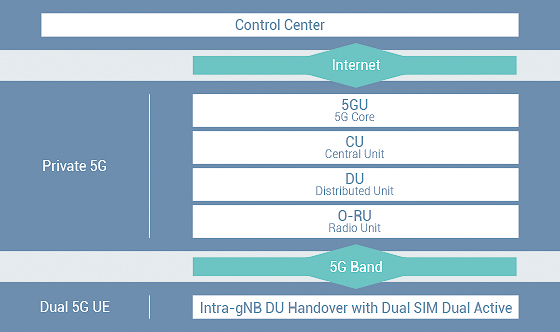
Figure 1. Solution building blocks.
Hytec Inter private 5G solution—including 5G Core, Central Units, Distributed Units, and Open Radio Units—is deployed along tunnels and controlled rail segments, covering areas where public networks cannot. In parallel, public 5G is leveraged wherever available, creating a seamless coverage envelope.
Onboard, NEXCOM ISA 141 serves as dual 5G onboard user equipment (UE), combining Dual SIM Dual Active (DSDA) capability with onboard buffering and a robust physical-layer design to improve link adaptation and reduce outage probability during network transitions. Two ISA 141 UE units are installed per wagon, mounted at both the front and rear, enabling simultaneous connectivity to public and private 5G networks.
Instead of reacting to link failures, the dual 5G DSDA architecture continuously monitors signal quality and end-to-end latency across both domains, allowing proactive and seamless handover decisions in real time.
When conditions change—such as entering areas with limited coverage—the ISA 141 automatically switches networks without service interruption. The decision logic is executed autonomously and programmed via a third-party operating system, ensuring deterministic behavior under extreme mobility conditions.
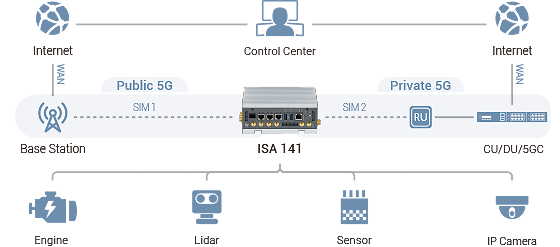
Figure 2. Application diagram.
Dynamic Resource Allocation for Critical and Non-Critical Traffic
Instead of physically separating networks by function, this architecture relies on 5G network slicing, enabled by Software-Defined Networking and Network Function Virtualization.
This allows multiple virtual networks to coexist on the same physical infrastructure, each engineered with independent performance characteristics. Rail services—including metro, regional, intercity, and high-speed operations—naturally map to the three core 5G service classes:
- URLLC for safety and control, where deterministic latency and reliability are mandatory
- mMTC for infrastructure monitoring, supporting large sensor populations with efficient signaling
- eMBB for passenger connectivity, treated as non-mission-critical and elastically scheduled
Such software-defined network architecture prioritizes safety-critical traffic over non-critical services when network conditions become constrained, maintaining predictable performance for control and safety functions while allowing other services to adapt dynamically, supporting overall operational continuity.
What Rail Operators Gain
By combining hybrid public–private coverage, dual 5G with DSDA connectivity, and network slicing, the solution delivers practical operational and business benefits across all rail transport types.
First, it enables zero-downtime connectivity across tunnels, rural areas, and public network boundaries, even at high speeds. Mission-critical control and monitoring remain uninterrupted during coverage transitions, eliminating one of the primary sources of operational risk.
Second, it reduces infrastructure and operational complexity. A single physical network replaces multiple isolated systems, simplifying planning, deployment, lifecycle management, and reducing total cost of ownership, while maintaining strict service separation.
Third, it enforces a safety-first approach, ensuring that safety-critical control and emergency communications are prioritized over other services under all network condition.
Finally, it establishes a future-ready foundation for smart rail evolution. Virtualized network functions and centralized control allow operators to scale services, integrate new applications, and adapt to changing requirements without re-engineering the physical infrastructure.
Operational Validation of a Unified 5G Railway Architecture
High-speed seamless handover solution is currently under technical evaluation with an Asian high-speed rail service provider, serving as a practical testbed for assessing how a unified 5G architecture performs under real rail operating conditions. The evaluation focuses high-speed 5G handover behavior and service continuity across heterogeneous coverage environments.
Hytec Inter and NEXCOM joint solution helps to implement critical services into operational practice across metro, regional, intercity, and high-speed rail systems. Rather than replacing established rail safety principles, it leverages software-defined mechanisms to enhance operational continuity and support the long-term sustainability of rail communication networks.
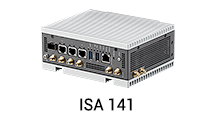 Key Features For Application Needs
- Intel Atom® x6413E processor SoC, BGA type
- 1 x SODIMM DDR4 3200 8GB module
- 1 x 40GB SSD module
- 1 x RJ45 console port
- 2 x USB 3.0
- 3 x 1GbE RJ45 with 1 combo port
- Dual Wi-Fi 6E
- Dual LTE/5G
- Dual DC (9~36VDC)
- Related Links:
- Surge Immunity by Design: EMC Strategies for IEC 61850/IEEE 1613 Network Gateways
- NEXCOM Brings Expanded Edge, Security, and Quantum-Resistant Innovations to MWC Barcelona 2026
- Browse Other News:
- Smart Rail Operations Requires New Network Foundation
- NEXCOM Debuts at NRA Show 2026 to Showcase Smart Retails and Foodservice Solutions Integrating Edge Computing and AI Odor-sensing Technology
- All Case Study News
