
Automate Away with the NDiS B364 Duro Edge Computer
The growth of industrial automation has increased demand for factories and warehouses that can handle growing workloads while scaling quickly. As e-commerce and logistics industries continue to expand, companies increasingly rely on automation to address labor shortages, operational inefficiencies, and workplace safety concerns.
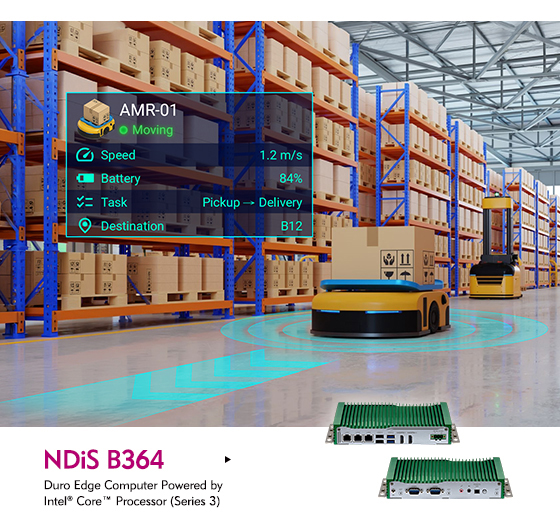
Enter the autonomous mobile robot (AMR). Unlike traditional automated guided vehicles (AGVs), AMRs can use onboard sensors and AI to understand their surroundings and navigate autonomously, taking on repetitive tasks such as transporting goods and materials. The AMR market is expected to reach USD 21.4 billion by 2033, reflecting the growing demand for intelligent mobile automation. NEXCOM addresses this demand with the NDiS B364 Duro Edge computer, designed specifically for AMR deployment.
The NDiS B364 is an edge AI fanless box powered by Intel® Core™ 7, Core™ 5, or Core™ 3 processors, with integrated NPUs for AI inference in industrial settings where AMRs thrive. Its 12V to 24V DC power input and -20°C to 60°C operating temperature range support deployment in demanding industrial environments. Flexible I/O options allow the NDiS B364 to connect with peripherals needed for AMR applications, while providing the computing capabilities for tasks such as object recognition, image analysis, and obstacle detection.
Efficient AI processing for smarter AMR operations
Industrial workspaces want to bring AI everywhere, but it also needs to be cost-effective. This means optimizing workloads to deliver high computing performance while keeping energy consumption low. The NDiS B364’s Intel® Core™ processors with the latest Wildcat Lake architecture do just that, delivering up to 41 TOPS of total AI computing power across the CPU, GPU, and NPU.
The platform combines an 18-TOPS Xe3 GPU, an 18-TOPS NPU, and a 5-TOPS CPU, nearly doubling the AI performance of the previous 22.5-TOPS Arrow Lake platform. The new Xe3 GPU alone provides more than 1.5 times the performance of the previous Arrow Lake architecture. These improvements enable the NDiS B364 to efficiently process low-power AI workloads such as image analysis and obstacle detection, while providing AMRs with the real-time computing capabilities needed to process information from onboard sensors.
Maximize AMR capabilities with tailored I/Os
Deploying AMRs in factories and warehouses can be a costly investment. The computer powering these AMRs shouldn’t have to be one too. That’s why the NDiS B364 is already tailored for these deployments with a selection of I/Os designed to support their operational needs.
The Duro Edge computer includes dual USB 3.2 ports for 3D cameras, two HDMI® 1.4 ports for operational monitors, and RS-422/485 serial interfaces for connecting motor drivers and the vehicle’s Battery Management System (BMS), enabling operators to monitor battery status and identify when recharging is needed. Its GPIO capabilities also support status inputs and alert outputs for detecting obstacle risks and presenting real-time power status information. Additionally, its high-bandwidth LAN connectivity supports 3D LiDAR sensors for real-time environmental scanning, obstacle detection, and path planning.
The NDiS B364 also includes three LAN ports, two 2.5GbE and one 1GbE, plus two expansion sockets: one Key B for optional LTE/5G and one Key E for optional Wi-Fi. These wireless connections allow AMRs to communicate with fleet dispatch systems for task assignment and traffic management, warehouse management systems (WMS) for order and inventory management, and remote monitoring platforms for vehicle status updates and OTA updates. The Key E socket can also support a third-party CAN FD module for additional vehicle connectivity. Meanwhile, the default line-out can be customized with speaker-out to support voice announcements, navigation guidance, and other audio alerts in noisy industrial environments.
Think smarter – and safer
Industrial environments can be hazardous for humans, with heavy machinery and large spaces creating potential safety concerns. AMRs can take over repetitive transportation tasks and operate alongside human workers, allowing people to spend less time moving through dangerous areas and more time on higher-value tasks such as planning and analysis. AMRs’ ability to use onboard sensing and obstacle detection also helps them respond to changing environments and operate more safely. With its AI processing capabilities and connectivity for onboard sensors, the NDiS B364 provides the computing foundation AMRs need to navigate dynamic industrial environments.
Main Features
- Intel® Core™ processor (Series 3): Core™ 7 processor 350/Core™ 5 processor 320/Core™ 3 processor 304
- Support Intel® ISM technology
- 1 x DDR5 6400 SO-DIMM, up to 64GB
- 2 x HDMI® 1.4, up to 4096x2160@30Hz
- 3 x Intel® LAN port (1 x 1GbE, 2 x 2.5GbE)
- 1 x USB 3.2 Gen 2, 1 x USB 3.2 Gen 1, 2 x USB 2.0, Type-A
- TPM 2.0 for security
- 1 x M.2 Key B 3052/3042 for an optional 5G/LTE module (PCIe 4.0 x1, USB 3.2)
- 1 x M.2 Key E 2230 for an optional Wi-Fi module (PCIe 4.0 x1, USB 2.0)
- 1 x M.2 Key M 2242 for an optional SSD (PCIe 4.0 x1)
- 1 x Remote switch, 1 x Mic in, 1 x Line out (default)/speaker out (dual channel upon request)
- 1 x Power button
- Support 12V~24V DC power input
Ordering Information
NDiS B364-350 (P/N: 10W90E30100X0)
Duro Edge computer, Intel® Core™ 7 processor 350 (Series 3)
NDiS B364-320 (P/N: 10W90E30101X0)
Duro Edge computer, Intel® Core™ 5 processor 320 (Series 3)
NDiS B364-304 (P/N: 10W90E30102X0)
Duro Edge computer, Intel® Core™ 3 processor 304 (Series 3)
- Related Links:
- Smarter Warehouse & Logistics Inspection Starts at the Edge with NDiS B340
- Store More Video. Unlock More Intelligence with NViS 6712
- Browse Other News:
- Automate Away with the NDiS B364 Duro Edge Computer
- Edge Computing Security Challenges: Risks, Threats, and Best Practices
- All Products News
