
|
|
[NOW OPEN] Make Future City into Reality: NEXCOM Future City Virtual Expo
NEXCOM Future City Virtual Expo is Now Open! Start...
[NOW OPEN] Make Future City into Reality: NEXCOM Future City Virtual Expo

|
Before the Numbers Could Talk: Verifying Energy Savings at a Water Treatment Plant
There is a version of this story that starts with meters and PLCs. This one starts with a harder question: how do you prove an energy-efficiency upgrade actually worked at a facility that can never go offline to find out?
The Challenge Behind the Upgrade
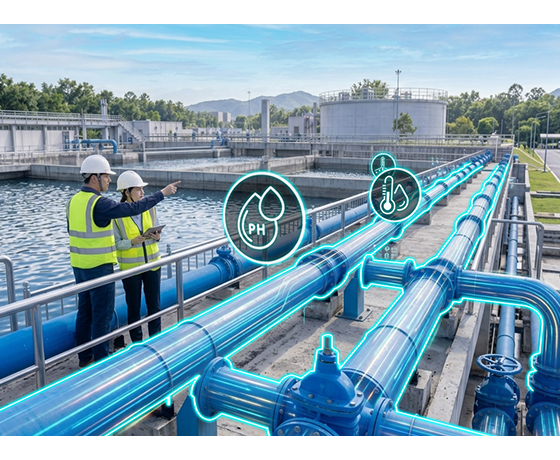
Located in the Hsinchu region, the water treatment plant supports both municipal and industrial water needs in the surrounding area. Hsinchu is also a major hub of Taiwan's advanced semiconductor industry, where companies such as TSMC first took root. Maintaining a stable water supply is therefore essential to both everyday life and the region's continued industrial operations.
As a critical piece of local water infrastructure, the plant had to maintain uninterrupted operation throughout every phase of modernization.
When key pumping equipment was replaced under an energy-efficiency initiative, the central challenge therefore extended beyond installation. The plant needed credible operating data to answer a much more consequential question: how much energy did the upgraded equipment save, and did the result meet the efficiency target specified for the project?
Four Questions, One Architecture
Once implementation began, it became clear that the original plan did not fully match what the site required. This is where NEXCOM Industry AIoT (NexAIoT Co., Ltd.) took on a broader consulting role, helping translate the original requirements into an architecture shaped by actual operating conditions. Four questions guided the work:
- What must be measured for the energy result to be credible?
No before-and-after comparison is meaningful if the underlying data has not been captured consistently. Establishing a reliable measurement foundation had to come first. - Which existing assets could continue to provide value?
The plant already operated an established control infrastructure. The task was to identify what could remain in service, what needed replacement, and how existing investments could be carried forward. - How should legacy and new systems communicate reliably?
The modernization introduced new PLCs and additional monitoring capability into an existing SCADA-based control environment. Reliable communication across generations and brands of equipment was essential. - How could energy management continue to serve the plant after project acceptance?
The system needed to support more than one verification exercise. The objective was to leave the plant with a usable foundation for ongoing monitoring, troubleshooting, demand management, and future efficiency improvements.
Each question became a design decision. Together, they turned a project specification into an operating architecture aligned with how the plant operates.
The Discovery That Reset the Project
The first question quickly became the most urgent. NEXCOM Industry AIoT found that parts of the original equipment plan did not fully align with the measurement requirements on site. Power meters, gateways, field equipment, and installation points all required further review to ensure that the resulting data could support a credible before-and-after comparison.
This was a fundamental issue. Without sufficient, properly positioned measurement points, even a sophisticated EMS could produce charts without being able to answer the question the project ultimately had to prove: how much energy was saved?
NEXCOM Industry AIoT reassessed the plant's energy-measurement requirements, identified missing coverage, recommended more appropriate installation points, and closed the gaps that would otherwise have weakened the verification process. Only after that foundation was established did the wider system architecture move forward.
That measurement discipline later became the basis of the formal energy-performance verification process. The project used an IPMVP-referenced measurement and verification methodology, combining voltage, current, power, power-factor, and water-flow data to evaluate the amount of electricity required per unit of water delivered. Data was acquired at one-minute intervals, allowing energy performance to be compared on a normalized basis rather than through raw power readings alone.
Building on What Already Worked
With the measurement foundation in place, the remaining questions turned to integration.
The plant already used SCADA as part of its industrial control environment, alongside existing PLC infrastructure. New PLCs were introduced to extend the control architecture and support the revised EMS requirements, while failed equipment was replaced where necessary. Existing assets that remained functional continued to be used.
At the OT layer, new smart meters and PLCs were added to extend monitoring coverage and bridge the plant's existing and newly deployed systems. These additions brought energy, equipment, and control data into the EMS over Ethernet, expanding visibility while preserving existing infrastructure.
At the center of the deployment, the NEXCOM NISE 3910E serves as the industrial computing platform supporting the EMS environment. JMobile provides the site-level visualization interface, bringing energy data together with selected signals from the existing FMCS environment, including equipment startup status. This gives operators and energy-management personnel a centralized view of equipment conditions and energy use across the facility. At the information layer, Node-RED supports data exchange between the connected systems.
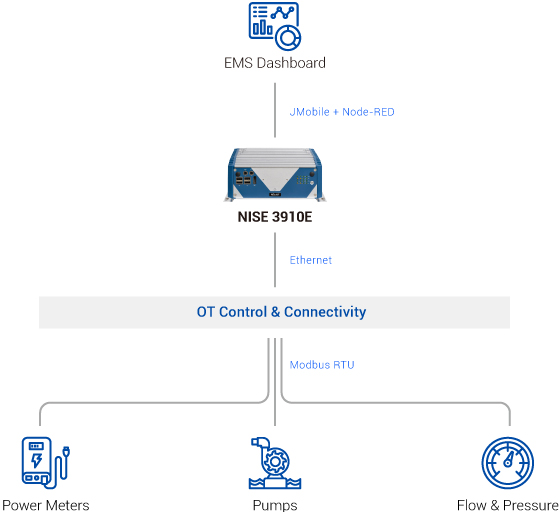
The result is a coordinated architecture built around the plant's existing operating environment: legacy systems continue to perform their established roles, new systems add the measurement and control capabilities the project required, and information that previously existed across separate control points can be managed through a common EMS environment.
This approach preserved useful existing investments, reduced unnecessary replacement, and lowered the operational risk associated with modernization in a continuously operating plant.
An Energy System That Understands Water
Demand control was part of the original tender requirements, but implementing it required more than watching electrical demand.
A water treatment plant has to satisfy hydraulic and supply conditions first. Pump operation therefore cannot be adjusted solely according to electricity consumption or peak demand. Flow, pressure, equipment status, and water-supply requirements all have to be considered together.
The system reflects that operating reality: JMobile integrates relevant SCADA signals, while the new PLC exchanges communication points with existing PLCs and SCADA to support motor start-stop control. Flow and pressure information are incorporated into the control logic so that pump and motor operation can be rotated according to actual supply conditions.
The same principle also shaped the energy-performance verification itself: lower electricity consumption only represents a real efficiency improvement when the amount of water delivered is taken into account. That is why the project evaluates performance in kilowatt-hours per cubic meter of water pumped, rather than relying on power consumption alone.
Furthermore, plant-wide power monitoring and demand alarms give operators visibility into peak-demand conditions, while the demand-control interface allows personnel to view pump status and intervene when necessary. Historical trend data also makes it possible to revisit abnormal periods and compare them with events such as water shortages, pump irregularities, or other unusual operating conditions.
What This Means for the People Running the Plant
Every layer of the system ultimately serves someone responsible for keeping the plant running.
Electrical and mechanical personnel gain a clearer record of motor and pump behavior. When operating conditions change or an abnormal trend appears, they have historical evidence available for investigation rather than relying only on observations made after the event.
Operators gain a centralized view of electricity use, equipment status, demand conditions, flow, and pressure, reducing the need to piece together the operating picture from separate field indicators.
Energy-management personnel can compare performance over time using a consistent data foundation, while management gains a clearer basis for evaluating whether equipment investment delivered the efficiency improvement that was expected.
The platform also connects energy use with electricity-cost management through tariff calculation, contract-capacity functions, variable electricity-charge records, and time-of-use tariff settings. The same energy data can therefore support both technical operation and management-level cost analysis.
That range of value—from plant operation to management review—is central to the consulting approach NEXCOM Industry AIoT brought to the project. The objective was to leave the plant with a system that remained useful after the acceptance process was complete.
What the Ledger Now Shows
Measurement and verification confirmed that the upgraded pumping system achieved a 17.6% project-level energy-saving rate, comfortably exceeding the specified 10.76% target. At the plant level, the improvement translated into a 2.7% energy-saving rate, also outperforming the required benchmark.
What makes these figures meaningful is the evidence behind them. The equipment upgrade delivered the efficiency gain, while the EMS made that gain visible, comparable, and verifiable through actual operating data. By strengthening the measurement foundation and establishing a consistent baseline, NEXCOM Industry AIoT gave the plant a result it can confidently demonstrate.
That level of execution is no accident. The plant's EMS environment, prior to this project, fell short of what a facility of its scale and importance required. Drawing on years of full-plant integration experience, NEXCOM Industry AIoT built the EMS into the complete, coherent system the plant needed.
Closing Thoughts: A Foundation, Not a Finish Line
What the plant gained extends well past this single verification cycle. It now holds a proven architecture and a verified methodology—one that will inform how the next modernization effort, here and elsewhere, gets scoped and carried out.
Measure. Compare. Verify. Improve. Measure again. That cycle is the throughline of the entire project, traceable back to the four questions that shaped it and to an architecture built around how the plant actually runs.
- Related Links:
- One Platform, 17 Systems, Zero Blind Spots: How a Taiwanese Snack Manufacturer Took Control of Multi-Plant Operations
- NEXCOM Joins Forces with Intel at COMPUTEX 2026: Defining New Standards for Smart Production Lines
- Browse Other News:
- Before the Numbers Could Talk: Verifying Energy Savings at a Water Treatment Plant
- What Is ROS 2? Architecture, ROS 1 vs. ROS 2, and Migration Guide
- All Case Study News
