
|
|
[NOW OPEN] Make Future City into Reality: NEXCOM Future City Virtual Expo
NEXCOM Future City Virtual Expo is Now Open! Start...
[NOW OPEN] Make Future City into Reality: NEXCOM Future City Virtual Expo

|
One Platform, 17 Systems, Zero Blind Spots: How a Taiwanese Snack Manufacturer Took Control of Multi-Plant Operations
Impact at a Glance
- Reduced Monitoring Headcount: Shift monitoring requirements decreased by 1–2 personnel through centralized visibility, automated data collection, and real-time alerts, freeing teams to focus on analysis and production decisions.
- Faster Operational Response: Detection cycles shortened from manual checks to continuous, automated monitoring, enabling teams to respond to operational abnormalities before production is affected.
- Proactive Energy Management: Real-time electrical load visibility and automated threshold alerts allow operators to intervene before utility demand limits are exceeded, upgrading energy management into an active control process.
- Scalable Multi-Plant Operations: A single remotely accessible SCADA platform now unifies more than 17 operational systems across multiple expanding sub-plants, providing the visibility and management infrastructure needed for continued growth.
Before vs. After Deployment
| Operational Aspect | Legacy Environment | After NEXCOM Deployment |
|---|---|---|
| Data Collection | Operators manually collected meter readings and equipment data every 1–2 hours, leaving critical visibility gaps between inspections. | Operational data is automatically collected and centralized in real time across all factory systems. |
| System Visibility | Production, utility, and environmental systems operated in isolation with no cross-system view. | A unified SCADA platform delivers centralized visibility across production, energy, water, and environmental infrastructure. |
| Energy Management | Utility demand issues were typically identified only after thresholds had already been exceeded. | Real-time monitoring and automated alerts enable operators to respond before demand limits are breached. |
| Anomaly Detection | Equipment abnormalities and environmental deviations were discovered during scheduled walkarounds — often hours after onset. | Real-time alarms accelerate investigation and enable response before issues escalate into production disruptions. |
| Workforce Requirements | Continuous monitoring required 4–5 personnel per shift for routine inspections and manual data collection. | Routine monitoring requirements reduced by 1–2 personnel per shift through automation and centralized oversight. |
| Management Access | Monitoring was limited to on-site control rooms. | Plant managers can remotely monitor operations through web-based desktop and mobile access from anywhere. |
The Challenge: Scaling Without Visibility
Our client, a major Taiwanese foods company, owns a primary manufacturing base for its classic and best-selling snack brands. In this high-throughput facility, precision is everything. Frying temperatures, ambient conditions, line yield rates, and process parameters must be exact. Any deviation, however small, can mean compromised product quality, increased waste, or an unplanned production halt.
As the client expanded capacity and brought new sub-plants online, maintaining that precision became increasingly difficult. More than 17 critical plant operations and production systems ran in isolation, each relying on its own interface and communication protocol. There was no unified view of the plant's massive data output, which included:
- Power Integration Monitoring: 11 distinct power panels continuously tracking voltage, current, power factor, and power consumption.
- Water Usage Monitoring: Front and back well systems tracking accumulated water consumption.
- Production Equipment: Fryers require strict oversight of vacuum pump temperature, pressure limits (PV/SV), fryer and condenser temperatures, frying timers, and basket lift intervals. Additionally, two NIR alarm systems track temperatures, active production recipes, and upper/lower recipe limits.
- Environmental Systems: Factory-wide temperature and humidity sensors.
Operators compensated by walking the floor every one to two hours to manually collect these highly granular meter readings and equipment states. It was heavily labor-intensive and left massive visibility gaps. If the fryer's vacuum pressure drifted out of spec, electrical demand on the facility's power panels crept toward utility thresholds, or ambient humidity shifted, no one knew until the next manual inspection. By then, the damage to product quality, energy costs, or production continuity was already done. Replacing infrastructure wholesale wasn't an option; the solution had to bridge these legacy systems without disrupting active production.
The NEXCOM Solution: A Unified Operational Center
Rather than replacing existing systems, NEXCOM Industry AIoT (NexAIoT Co., Ltd.) engineered a solution around them, deploying a centralized SCADA platform that could unify the facility's existing EMS, environmental monitoring, and production systems through a single, coherent interface.

At the core of the deployment is a two-tiered architecture bridging the factory's field devices and the supervisory system. The nDAS 6000 data acquisition (DAQ) gateway acts as a universal translator, leveraging its extensive protocol support to extract and normalize real-time data from all 17 isolated systems—including production fryers, high-voltage power panels, and water meters. This unified data stream feeds directly into the NEXCOM NISE 3900R industrial computer running JMobile SCADA. By consolidating these previously scattered metrics into one real-time environment, the platform gives operators a complete, single-dashboard view of facility conditions without the need to navigate competing interfaces.
Critically, the deployment improved operational visibility without requiring major infrastructure replacement. Existing EMS and environmental monitoring systems were integrated into the unified platform, protecting prior technology investments while extending their usefulness.
Real-Time Monitoring and Response
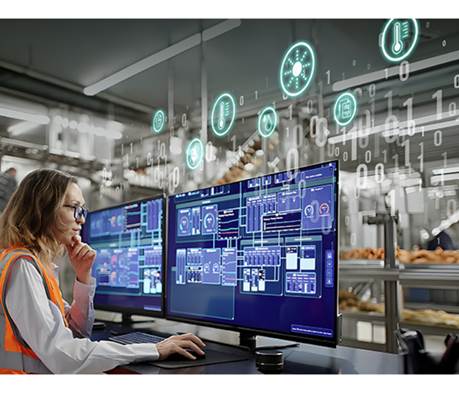
Instead of running across the factory floor to check isolated control panels, operators and plant managers now see the entire facility from a single screen, accessible on desktop or mobile from anywhere. Through JMobile SCADA, teams now have continuous access to:
- Live plant visualization across all connected systems
- Real-time operational data and trend analysis
- Automated alarm notifications for threshold breaches and anomalies
- Historical performance records for root cause analysis and reporting
- Remote monitoring via web-based desktop and mobile access
When an abnormality occurs, such as a temperature deviation on a frying line, an unexpected equipment reading, or a power demand spike, affected systems are immediately visible. Teams can review current operating conditions and coordinate corrective action before issues escalate into batch losses, quality failures, or production stoppages.
Outcomes
Improved Operational Efficiency
Following deployment, routine shift monitoring requirements decreased from 4–5 personnel to 3–4 personnel, while continuous visibility across operations was maintained and improved.
Automated data collection, centralized dashboards, and real-time alerts eliminated the manual walk round cycles that had consumed significant operator time. Teams now spend less time gathering information and more time acting on it: analyzing conditions, anticipating issues, and supporting production decisions.
Faster Decision-Making and Operational Response
Near real-time visibility into production, environmental, and utility conditions has fundamentally changed how the facility responds to operational events.
Equipment abnormalities and environmental deviations that once depended on scheduled inspections can now be identified and investigated within minutes. Faster detection means faster coordination: production, engineering, and maintenance teams align on response actions earlier, reducing the likelihood of prolonged disruptions or quality impacts across production lines.
Predictive Energy Control and Hazard Prevention
The platform transforms energy management from reactive oversight to predictive control by providing deep trend analysis of critical metrics like voltage, current, power factor, and accumulated consumption. By visualizing emerging energy trends over time, operators can anticipate peak demands and take preemptive action—such as staggering equipment startups or adjusting production runs—long before utility demand thresholds are even threatened.
Beyond cost optimization, continuous monitoring provides a crucial layer of electrical safety. Tracking anomalies in power signatures acts as an early warning mechanism for equipment degradation. Maintenance teams can instantly detect irregularities, such as capacitor aging or abnormal thermal stress, enabling them to intervene early and prevent dangerous electrical hazards or costly factory fires.
Scalable Multi-Plant Operations
As our client continues expanding across multiple facilities and sub-plants, centralized visibility has become a core operational capability rather than a convenience.
Real-time alerts are automatically delivered whenever operational abnormalities or environmental deviations occur. Plant managers can remotely monitor facility conditions, review live operational data, and coordinate responses without being physically present on the factory floor. The unified architecture is designed to absorb new systems and facilities as expansion continues, without adding monitoring complexity.
Conclusion
By unifying more than 17 previously fragmented systems into a centralized SCADA platform, NEXCOM Industry AIoT helped our client move from reactive monitoring to genuine operational control. The deployment improved visibility across critical production and facility systems, reduced manual monitoring workloads, accelerated response to abnormalities, and gave management teams the remote access and scalability needed to grow with confidence.
All of this was achieved without replacing existing infrastructure, allowing our client to modernize operations while fully preserving prior technology investments.
Today, the centralized architecture provides the operational visibility, responsiveness, and management capabilities that a high-throughput food manufacturing environment demands, along with a strong foundation for whatever expansion comes next.
- Related Links:
- NEXCOM Joins Forces with Intel at COMPUTEX 2026: Defining New Standards for Smart Production Lines
- Physical AI Hits the Factory Floor: Predictive Optimization for Chemical Processes
- Browse Other News:
- Hybrid Video Surveillance Architecture: What Stays Local and What Moves to the Cloud
- What is an Industrial IoT Gateway? The Ultimate Guide for Industry 4.0
- All Case Study News
