
AMR Robotics Guide: Technology, Industrial Applications, and Benefits
What is AMR Robotics?
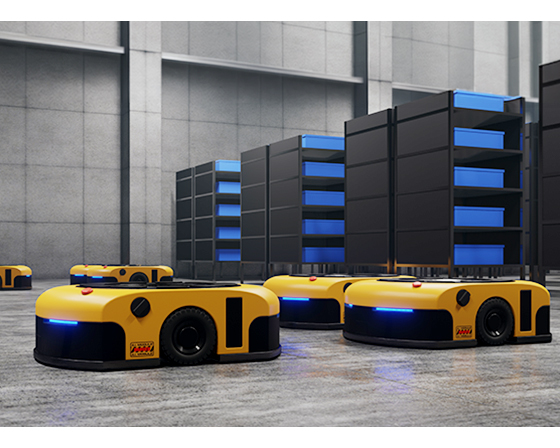
Autonomous Mobile Robots (AMRs) are intelligent machines designed to navigate and operate in dynamic environments without relying on fixed paths or physical guides. Unlike traditional automation systems, AMR robotics leverages real-time perception, decision-making, and movement—making it a key enabler of modern industrial automation.
At a basic level, AMRs use onboard sensors, mapping technologies, and path-planning algorithms to understand their surroundings and move materials efficiently. This allows them to adapt to changing layouts, avoid obstacles, and optimize routes in real time.
AMR vs. AGV: What’s the Difference?
While both AMRs and Automated Guided Vehicles (AGVs) are used for material handling, their core capabilities differ significantly:
- AGVs follow predefined paths using magnetic strips, QR codes, or wires
- AMRs dynamically navigate using sensors and intelligent software
This distinction is critical. AMRs are not just automated movers—they represent a shift toward Embodied AI, where machines can sense, decide, and act within physical environments. This makes them far more flexible and scalable in modern industrial settings.
The Core Components of an AMR System
Sensors and Perception
Ever wondered how a mobile platform can tell the difference between a person stepping into its path, a moving forklift, and a static rack? It combines LiDAR, cameras, depth data, IMU signals, and wheel feedback for a live spatial picture that is detailed enough for detection, free-space estimation, and motion awareness. This is how AMR technology begins. Sensor fusion keeps intelligence grounded in what is happening right now, not what was mapped earlier.
SLAM and Navigation
Once that scene is understood, how does the machine keep its bearings while the floor keeps changing? SLAM (Simultaneous Localization and Mapping) updates both the pose and the map, as well as combines lidar or vision with odometry and inertial data. This is why real-time localization can help with path generation and obstacle avoidance even in case of only partially blocked aisles or partially known layout.
Wireless Connectivity and Edge Computing
After that, another question arises. Where should all that computing happen when every millisecond counts? Wi-Fi or 5G links the robot to nearby edge infrastructure. Consequently, heavy tasks such as remote inference, collaborative SLAM, and fleet coordination can be done off-board without the delays that come with cloud processing. This provides edge AI for robotics with the fast feedback loop that makes embodied interaction possible on a busy industrial floor.
Common Types of AMR Robots in Manufacturing and Warehousing
Cart Robots
Need an easy way to move totes, kits, or WIP between staging, assembly, and pack-out without burning labor on back-and-forth travel? Cart robots are the light-duty movers in AMR robotics. They are made for tasks that need to be done over and over again. In this case, brute force is not as significant as payload stability, rapid docking, and smooth integration with carts or roll cages.
Tugger Robots
But what if one trip is not enough? That is the point when tugger robots come in. Instead of carrying one load, they pull a train of carts for line-side delivery, milk runs, end-of-line transfer, and other high-volume intralogistics loops. This is why AMR technology is so useful in plants that need a steady flow without having to haul things around by hand all the time.
Shelf-Stocking or Picking Robots
Now, if order assembly is the bottleneck, why send people walking aisle after aisle? Shelf-stocking and picking robots are made for goods-to-person and in-aisle fulfillment workflows. They can either bring shelves or totes to fixed stations or go to storage areas, which decreases the amount of walking time and increases pick density in fast-moving operations.
Service and Inspection Robots
And what about the equipment itself once the flow of materials is under control? Service and inspection robots are used for autonomous rounds that collect thermal, acoustic, and visual data from assets in dangerous or hard-to-reach places. This makes routine patrols a structured way to learn about the condition of assets for predictive maintenance and uptime protection.
Key Use Cases for AMR Robotics Across Industries
Warehousing and Logistics
Robot shipments may climb by 50% and warehouse automation by more than 10% per year. Why are distribution teams so quick to consider AMR technology? The payoff is orchestration and not just movement. In warehouse fulfillment automation, mobile fleets can collect carts or pallets from handoff zones, eliminate the non-value walking that drains labor, and let execution software reprioritize work as order waves vary. In this manner, people can concentrate on exceptions and decision-making, and the transport layer maintains cycle time and service levels.
Smart Manufacturing and Factory Automation
Then, go to the plant floor and ask yourself, "What could be more important than getting the right part to the right station at the right time?" In AMR robotics, the answer is coordinated flow. It implies feeding kitting areas, AS/RS interfaces, and manual or automated workcells in sync with production demand. Thus, smart factory automation is not so rigid, easier to trace, and better at mixing autonomous execution with human oversight when things change during a run.
Advantages and Challenges of AMR Technology
| Advantages | Challenges |
|---|---|
| Efficiency Centralized dispatch, traffic arbitration, and priority-based job assignment help fleets keep the flow of materials in line with plant demand. Continuous multi-hour operation decreases idle waiting and manual travel time. |
Connectivity Mobile robots need stable roaming between coverage zones. If there are dead spots, interference, or poor handoff performance, it can make latency-sensitive control, telemetry, and safety-related communications difficult unless the wireless layer is meant for industrial mobility. |
| Safety LiDAR-based 360° protection, dynamic safety fields, and controlled movement around people and equipment all help reduce the risks associated with internal material transport, such as collisions and unsafe interactions with people or equipment, and the need for repetitive manual transport. |
Integration Real value only comes out when mission logic is linked up properly with MES, ERP, WMS, PLC, and station-level workflows. This implies that engineers have to deal with API mapping, device handshakes, job-state synchronization, and exception recovery across different software layers. |
| Cost Reduction AMRs may avoid non-value-added handling and fixed infrastructure changes, as well as boost uptime, thanks to automated transport tasks that take up a lot of manufacturing labor. It justifies many deployments via productivity and ROI gains. |
Battery Management To make the most of high utilization, charging must be mission-aware, show the current state of charge, and have policies that balance queue demand with recharge windows. If these things are not in place, poorly timed charging or uneven cycling can cause availability losses and speed up pack wear. |
Powering Your AMR Robotics with NEXCOM Solutions
So, what role do we play at NEXCOM? We think of ourselves as the infrastructure layer that keeps AMR technology reliable in the field. Our edge computing platforms can be integrated with CODESYS software to function as PC-based PLCs, enabling precise motion control for AMRs. By supporting I/O integration with vision modules such as LiDAR and GMSL cameras, these systems provide the environmental perception, scene mapping, and path planning capabilities required for autonomous operation. We also offer wireless connectivity and the computing power needed for various AMR applications.
We focus on high-reliability edge AI computing platforms with the processing headroom, sensor-facing I/O, wireless options, and rugged design to keep inference, control, and data exchange close to the machine. This is what makes AMR robotics more responsive and easier to service in real-world conditions. If you are looking for that kind of foundation, we invite you to check out our solutions or get in touch with us.
Frequently Asked Questions
How much do AMR robots cost?
In the context of AMR robotics, the honest answer is that it depends on the job design more than the frame itself. Some entry-level transport autonomous mobile robots may cost $50,000-$85,000. But current production-ready and heavy-duty AMRs may cost $100,000-$150,000. The number goes up to over $200,000 for custom-engineered systems. That is when you add robotic arms, conveyor toppers, and industry-specific configurations.
Are AMR robots safe to work with humans?
Yes, AMR technology is practical, but only if it is set up as a governed system and not as a stand-alone machine. ISO 3691-4 covers driverless industrial trucks like AMRs. OSHA (Occupational Safety and Health Administration) says that robotics accidents happen during setup or maintenance, not during normal operation. Modern platforms have certified safety functions. Hence, industrial mobile robot safety depends on validated risk assessment, application limits, and disciplined commissioning in the workspace.
- Related Links:
- What Is ROS 2? Architecture, ROS 1 vs. ROS 2, and Migration Guide
- What Is Manufacturing Process Automation? Types, Benefits, Use Cases, and 7 Implementation Steps
- Browse Other News:
- Smarter Warehouse & Logistics Inspection Starts at the Edge with NDiS B340
- NEXCOM Introduces RoboWIZ AI Robotics Platform at GTC Berlin
- All Blog News
