
|
|
2015 Corporate Video
The IoT creates unprecedented opportunities in the...
2015 Corporate Video

|
When the Control Room Needs an Answer: Building the Local Video Node for Centralized Transportation Monitoring
A transportation control room watches countless ordinary moments at once: passengers moving through platforms, vehicles arriving and leaving, staff crossing service areas. Cameras record continuously in the background.
Then one moment matters. An incident is reported. An operator opens the relevant camera, checks the live feed, then jumps back through the timeline to see what happened. Another view may provide context while the rest of the site stays under watch.
The workflow should feel simple: find the camera, find the moment, understand what happened. Behind it, several workloads are running at once. Recording continues. Historical footage is retrieved. Selected streams are decoded for live view and playback. VMS services stay active, and new video keeps arriving.
That makes the local video node more than a recorder. It needs the storage, compute, and expansion capacity to keep these workloads running together. NViS 6712 is built for this role.

Built for the Control Room
Investigate an Incident While Recording Continues
A report comes in from a busy station platform. The operator locates the relevant camera, checks the live view, then moves back through the recording to identify when the incident began. A second camera reveals what happened from another angle. At the same time, other operators may be reviewing separate events, and cameras across the station continue recording.
These overlapping activities place demands on the local video infrastructure. NViS 6712 combines 12 × 3.5-inch HDD bays for high-volume video storage with two M.2 2280 NVMe SSD slots and an additional M.2 SATA SSD slot for system and application data. This gives system integrators dedicated storage options for continuous video archives and active application workloads.
Powered by Intel® Core™ Series 2 processors with up to 12 P-cores, 24 threads, 5.9 GHz Turbo, 36MB L3 cache, and 64GB DDR5 memory, the platform provides the computing resources for VMS services, footage retrieval, playback, and other application processing alongside ongoing recording.
For operators, the objective is practical: review the footage they need without interrupting the recording work happening across the station.
Retrieve Footage When Questions Arise Later
Not every incident is reported immediately. A passenger may contact station management days after losing a personal belonging, or an operations team may need to reconstruct the sequence of events behind a service disruption. The operator must locate the correct camera, return to the reported time, and review the available footage to establish what happened.
Whether that footage is still available depends on how the video archive was planned. A busy platform with multiple high-resolution cameras may generate considerably more data than a service corridor, while different recording schedules and retention policies further affect storage requirements.
With 12 HDD bays supporting up to 312TB of raw JBOD capacity, NViS 6712 provides a high-capacity foundation for local video retention. System integrators can size the storage configuration around actual recording profiles, including camera count, resolution, frame rate, codec, bitrate, recording schedule, and retention period, while accounting for storage protection and system overhead.
For the control room, effective retention planning supports a fundamental investigative need: the ability to return to the relevant footage when questions arise, even days after an event.
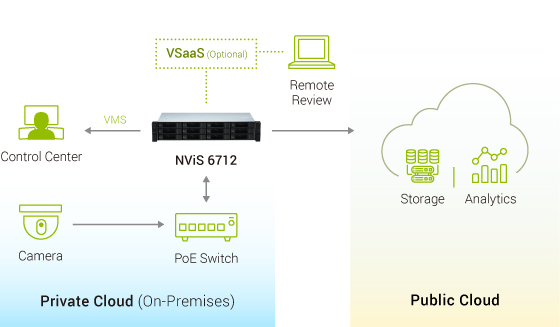
Extend Selected Video Services Beyond the Site
Transportation operations may span multiple stations, terminals, or facilities. In a hybrid VMS or VSaaS architecture, high-volume recording and retention can remain local while selected services—such as remote access, alerts, metadata management, event clips, and multi-site management—extend centrally.
NViS 6712 provides the local recording, storage, and compute foundation, while the selected VMS or VSaaS software manages authentication, remote access, notifications, and cross-site coordination.
Dual 2.5GbE interfaces provide base network connectivity, with PCIe expansion available for projects that require additional networking options. This keeps the high-volume video workload close to the site while extending the information and services that benefit from wider access.
For a broader look at this local-versus-central design approach, see Hybrid Cloud Video Surveillance Architecture: What Stays Local and What Moves to the Cloud.
Different Sites, Different Surveillance Needs
A busy transit interchange and a smaller commuter station may use the same video platform, but their operational priorities can differ.
At a major transportation hub, cameras continuously capture activity across platforms, entrances, and service areas. When an incident is reported days later, operators need access to the historical footage. For deployments where recording volume and retention are the primary concerns, NViS 6712 can be configured with capacity-oriented JBOD storage. When critical footage also needs protection against selected drive failures, a validated hardware RAID configuration can add an extra layer of storage resilience.
Other locations may need more intelligence at the edge. At a crowded interchange, for example, video analytics could help identify growing congestion near ticket gates or platform entrances. NViS 6712 offers PCIe and M.2 expansion options for compatible AI accelerators, while analytics can be deployed in cameras, on the local server, on dedicated AI nodes, or centrally, depending on application requirements.
Ultimately, the right configuration depends on what each site needs to capture, preserve, and understand.
Keep the Control Room Ready for What Comes Next
When an incident draws attention to one platform, the rest of the station keeps moving. Operators must locate the right cameras, review earlier footage, and compare multiple views while recording continues across the site. To support these concurrent workloads, NViS 6712 by NEXCOM Smart Vision (GreenBase Technology Co., Ltd.) brings together high-capacity local storage, P-core-only processing, fast SSD storage options, and flexible expansion in a 2U platform.
For transportation hubs and multi-site operations, system integrators can tailor the platform to each site's recording, retention, and processing requirements, while compatible VMS or VSaaS software extends selected services across locations.
Because in a control room, understanding what happened should never come at the expense of seeing what happens next. Explore NViS 6712 now.
- Related Links:
- Hybrid Cloud Video Surveillance Architecture: What Stays Local and What Moves to the Cloud
- Store More Video. Unlock More Intelligence with NViS 6712
- Browse Other News:
- When the Control Room Needs an Answer: Building the Local Video Node for Centralized Transportation Monitoring
- Before the Numbers Could Talk: Verifying Energy Savings at a Water Treatment Plant
- All Use Case News
