
AI-Powered PPE Monitoring for Safer Steel Coil Packaging Operations
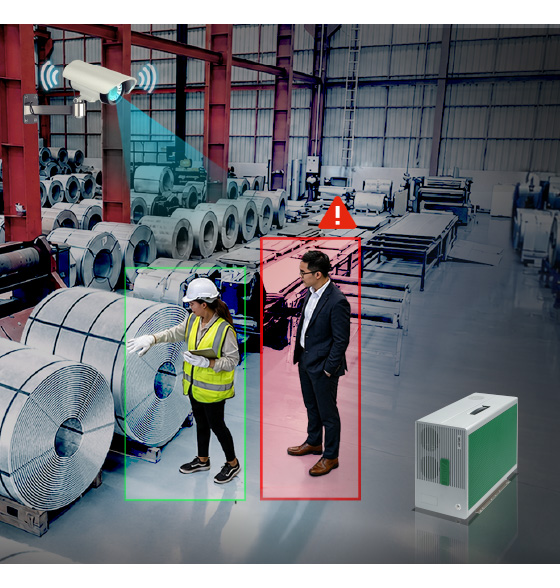
Impact at a Glance
When PPE compliance breaks down, safety risks escalate quickly. A 2024 meta-analysis published in BMC Public Health, covering 36,470 workers across nine countries, found that workers who failed to wear personal protective equipment (PPE) were 4.06 times more likely to be injured than compliant workers, making PPE non-compliance a greater risk factor than nightshift work or years of service.
Many steel coil packaging facilities still rely on periodic patrols and post-incident video reviews, creating gaps where PPE violations can go unnoticed. In contrast, edge AI-powered monitoring closes these gaps through continuous detection, real-time alerts, and automated compliance documentation.
| Area | Traditional Approach | AI Edge Vision Approach |
|---|---|---|
| PPE Monitoring | Manual floor patrols | Continuous automated monitoring |
| Violation Response | Supervisor-dependent | Automated real-time alerts |
| Incident Review | Post-incident video review | Immediate detection and logging |
| EHS Workload | High manual inspection burden | Reduced audit and inspection effort |
| Compliance Records | Fragmented manual review | Centralized digital audit trail |
From Periodic Patrols to Continuous Coverage
Manufacturers supplying tinplate packaging materials to the global F&B industry operate highly automated facilities where worker safety remains critical. For instance, in steel coil packaging environments, employees routinely work around heavy materials, lifting equipment, and automated machinery. PPE requirements — safety helmets, protective eyewear, wrist guards — help reduce workplace risk, but ensuring consistent compliance across multiple work zones is a resource-intensive task that traditional methods struggle to meet.
In a typical operation, supervisors oversee several production areas simultaneously. Routine patrols catch visible violations but cannot continuously track every worker across an entire shift. Legacy surveillance systems face the same ceiling: footage supports investigations after an incident but does nothing to prevent the next one.
The result is a set of operational risks: PPE violations go undetected between patrols. Unsafe behavior persists for minutes or hours before anyone intervenes. Audit preparation consumes significant EHS hours. And without trend data, recurring safety risks stay invisible until they become incidents.
This is where automated monitoring steps in and directly addresses each of these gaps.
How NEXCOM's Edge AI Computing Solution Works
NEXCOM Industry AIoT's (NexAIoT Co., Ltd.) edge AI portfolio delivers intelligent PPE monitoring directly within industrial environments by combining industrial cameras, edge AI processing, automated alerts, and centralized reporting into a single continuous safety workflow. The objective is clear: automatically identify sustained PPE violations, notify personnel in real time, and maintain a searchable compliance record for future review.
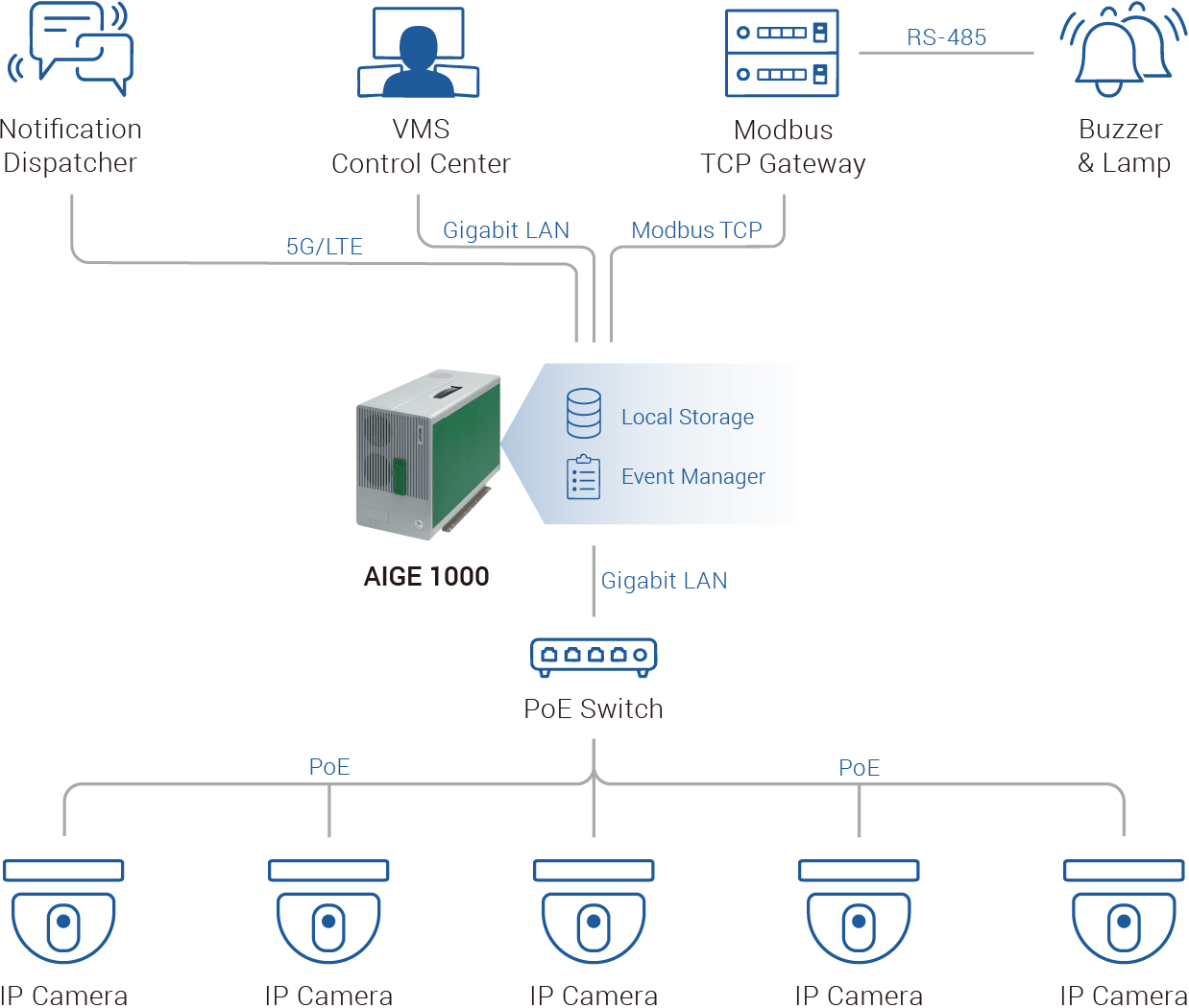
A typical deployment runs on the NEXCOM AIGE 1000 C10, which processes real-time monitoring workloads locally at the edge across four integrated functions:
1. Video Capture
Multiple IP cameras installed across packaging lines, lifting zones, and material handling areas feed live streams via Gigabit LAN. Coverage is continuous throughout operating hours, not limited to inspection windows.
2. AI Detection
Video streams are analyzed in real time by AI vision models running locally on the edge platform. The system detects missing PPE and other site-specific equipment with sustained accuracy above 91%. To eliminate false positives from routine adjustments, a configurable persistence threshold requires a violation to appear across 100 frames within a 10-second window before triggering a response.
3. Automated Alerting
When a sustained violation is confirmed, the system immediately activates warning lights and buzzers through the plant's alarm system via Modbus TCP. Simultaneously, incident footage and event details are logged to the central monitoring platform, which distributes real-time notifications to safety personnel's mobile devices. Because alerts fire while the unsafe behavior is still occurring, corrective action begins in real time; not after the fact.
4. Incident Documentation
Raw footage is recorded locally with a 7-day auto-purge policy. When a violation is detected, a 30-second clip is automatically extracted and dispatched to the centralized VMS database for long-term retention and audit access. All events are tagged and searchable, allowing safety personnel to locate specific incidents in seconds rather than scrubbing through hours of footage.
What This Means for EHS Teams and Plant Operations
Deploying continuous AI-powered PPE monitoring produces tangible operational improvements across safety management, compliance, and audit readiness.
1. Safety personnel shift from reactive to proactive.
Routine monitoring is automated across all production areas, freeing EHS teams from repetitive patrol cycles. Instead of managing inspections, safety personnel focus on interpreting data, addressing root causes, and advancing higher-priority safety initiatives.
2. Violations are caught and corrected faster.
Real-time alerts shorten the window between unsafe behavior and intervention from hours to seconds. Violations that previously went unnoticed between patrols are now flagged and addressed while they are still happening.
3. Audit preparation becomes a matter of minutes.
Automatically tagged incidents, searchable video records, and system-generated violation reports replace the manual documentation process. When internal reviews or external audits occur, the evidence is already organized and ready.
4. Compliance trends become visible and actionable.
Historical event data reveals which production areas generate the most violations, which PPE types are most frequently missing, and whether compliance improves or deteriorates over time. EHS teams move from reacting to incidents to preventing them through targeted, data-driven interventions.
5. Enforcement standards become consistent across shifts.
Automated detection applies the same criteria at 6 AM as it does at 10 PM, eliminating the variability inherent in human observation across different supervisors, shifts, and fatigue levels.
One Edge Platform, Multiple Applications
Real-time analysis of multiple high-resolution video streams demands serious computing infrastructure. Built for this exact workload, the AIGE 1000 C10 supports Intel® 12th, 13th, and 14th Gen Intel® Core™ processors and features a PCIe x16 expansion slot capable of accommodating high-performance GPUs with up to 500W power consumption. This provides the AI acceleration necessary to run advanced computer vision models at low latency without relying on cloud connectivity.
Because processing happens entirely at the edge, video data never leaves the facility. Network bandwidth requirements stay low, response latency remains minimal, and operations are unaffected by internet disruptions—a critical advantage for manufacturers where reliability and data sovereignty are non-negotiable.
PPE monitoring is only the beginning. The system eliminates single-purpose hardware, acting as a unified foundation for facility-wide intelligence. Using existing cameras, manufacturers can instantly activate new AI workloads—expanding from basic helmet detection to forklift tracking and intrusion alerts.
Build Safety Infrastructure That Scales
PPE compliance is not a problem that periodic inspections can fully solve in high-activity production environments. The gaps between patrols are where violations persist, incidents develop, and audit trails go dark.
NEXCOM Industry AIoT's edge AI platform closes those gaps. It turns passive surveillance infrastructure into an active safety system: It detects violations in real time, triggers immediate corrective action, and produces compliance records that manual oversight cannot reliably generate.
This architecture extends directly to production. The same engine driving safety protocols also powers visual quality inspections and predictive maintenance. As operational demands grow, simply upgrade the GPU without replacing the platform, maximizing ROI as your facility scales.
For manufacturers ready to move beyond reactive safety management, the AIGE 1000 C10 provides the foundation: proven in demanding industrial environments, built for continuous AI workloads, and designed to expand as operational requirements evolve.
- Related Links:
- No Escape for Robot Hackers: Breaking the Kill Chain with AI/ML-Driven OT Cybersecurity in E-Commerce Warehouses
- Physical AI Hits the Factory Floor: Predictive Optimization for Chemical Processes
- Browse Other News:
- Smarter Warehouse & Logistics Inspection Starts at the Edge with NDiS B340
- NEXCOM Introduces RoboWIZ AI Robotics Platform at GTC Berlin
- All Use Case News
