
|
|
2015 Corporate Video
The IoT creates unprecedented opportunities in the...
2015 Corporate Video

|
Store More Video. Unlock More Intelligence with NViS 6712
What happens when a surveillance system has to keep recording while VMS, playback, databases, and AI analytics all compete for resources?
Modern video infrastructure needs more than storage capacity. It also requires fast data access and consistent compute performance to keep concurrent workloads running smoothly.
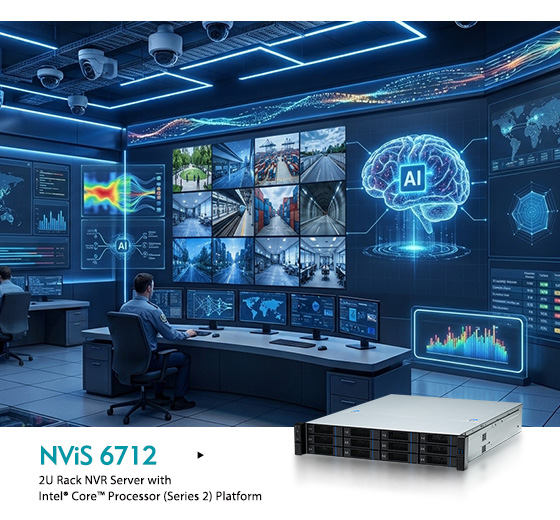
NEXCOM NViS 6712 brings these resources together in one 2U platform, combining 12-bay high-density storage, dual NVMe SSDs, Intel® Core™ Series 2 processing, and flexible AI expansion for recording, applications, and analytics.
Scale Video Retention Without Scaling Complexity
Higher-resolution cameras generate better evidence, but also much more data. NViS 6712 addresses this with 12 x 3.5-inch HDD bays, supporting up to 312 TB of total JBOD raw capacity for long-duration, multi-camera recording and continuous high-bitrate video streams.
By consolidating high-capacity storage in a single 2U chassis, the platform supports longer retention periods while reducing reliance on separate storage appliances.
In AI-enabled surveillance workflows, the HDD array can preserve large volumes of raw video while higher-speed resources handle applications, metadata, databases, and analytics. This keeps more historical footage available for investigation, review, and downstream analysis while faster storage tiers remain focused on active workloads.
Keep Concurrent Workloads Responsive
NViS 6712 supports Intel® Core™ Series 2 processors, with configurations offering up to 12 Performance-cores, 24 threads, Turbo frequency up to 5.9 GHz, and 36 MB of L3 cache.
Its P-core-focused architecture provides a consistent pool of high-performance compute resources for concurrent VMS, playback, database, video-processing, and AI workloads. This helps maintain predictable performance when multiple applications need to run alongside continuous recording.
The result is a compute platform better suited to surveillance environments where recording, playback, data processing, and analytics must operate simultaneously under sustained workloads.
Separate Workloads to Reduce I/O Contention
NViS 6712 supports two M.2 2280 NVMe SSDs, providing separate high-speed storage resources for different workloads. For example, one NVMe SSD can support the OS and VMS applications while the other handles databases, metadata, AI cache, or other active data workloads. This separation helps reduce I/O contention and keeps applications responsive during concurrent processing.
It also simplifies maintenance by isolating system applications from data-intensive workloads. HDDs provide capacity. NVMe provides speed. Dual NVMe helps keep speed-sensitive workloads from competing for the same storage path.
Scale from Recording to AI Analytics
As surveillance moves beyond passive recording, AI is playing a larger role in how video is analyzed, searched, and acted upon. NViS 6712 supports this shift with an expandable architecture that lets customers scale AI acceleration according to deployment needs.
The system provides PCIe x16 Gen5 expansion for graphics or AI acceleration cards, along with M.2 support for AI accelerator modules. Support for Intel® OpenVINO™ and Intel® Quick Sync Video further extends the platform for AI inference and video-processing workloads.
Potential applications range from object recognition and event detection to image analysis and intelligent video search. Customers can right-size AI acceleration for current workloads, then expand as analytics demands grow.
Keep Video Local While Extending Services to the Cloud
Cloud-connected doesn't have to mean cloud-dependent. NViS 6712 works as a cloud-connected local recording and analytics node, keeping video storage and processing on-site while connecting to cloud-based services.
Acting as the bridge between cameras and the cloud, NViS 6712 can keep high-volume footage stored and processed locally while selected video, events, metadata, or alerts are delivered to cloud applications. This reduces the need to continuously move raw video across the network while maintaining remote access and centralized visibility.
For VSaaS providers and solution partners, this hybrid architecture supports centralized multi-site management, remote viewing, storage relay, playback, and cloud-based services while preserving local recording, storage, and analytics resources at the edge.
Prepare for Emerging Physical AI Workflows
Looking further ahead, the same video infrastructure can support AI model training for Physical AI development. Robots and autonomous systems rely on large volumes of real-world visual data to understand dynamic environments such as factories, warehouses, and roads.
In this emerging workflow, NViS 6712 can serve as a local data collection and preprocessing node. It stores raw footage on HDDs, keeps active datasets on NVMe, and uses compute and AI acceleration resources for tasks such as recognition, labeling, and preprocessing.
This gives collected video a potential role in downstream development of Vision-Language Models (VLMs) and Vision-Language-Action (VLA) models, extending its value beyond security and analytics.
Key Features
- 2U high-density NVR — 12 x 3.5" HDD bays for scalable video storage
- Intel® Core™ Series 2 — P-core-only architecture for consistent high-performance processing
- Tiered storage — 2 x NVMe SSD + 1 x M.2 SATA SSD for workload separation
- Up to 64GB DDR5 — More memory for demanding applications
- AI-ready expansion — PCIe x16 for GPU and accelerator cards
- Dual 2.5GbE — High-speed network connectivity
- Multi-display support — DP 1.4 + HDMI® 2.0b + HDMI® 1.4
- Integrated audio I/O — Audio in/out and microphone support
- Related Links:
- Hybrid Cloud Video Surveillance Architecture: What Stays Local and What Moves to the Cloud
- NViS 6708: The Next Generation of Surveillance Storage - A 2U Rackmount Workstation NVR with High Storage Capacity and High-Speed Storage
- Browse Other News:
- Smarter Warehouse & Logistics Inspection Starts at the Edge with NDiS B340
- NEXCOM Introduces RoboWIZ AI Robotics Platform at GTC Berlin
- All Products News
